Showing posts with label Diabetes UK. Show all posts

Wednesday, 15 July 2015

#135shoes - 108 unnecessary amputations a week

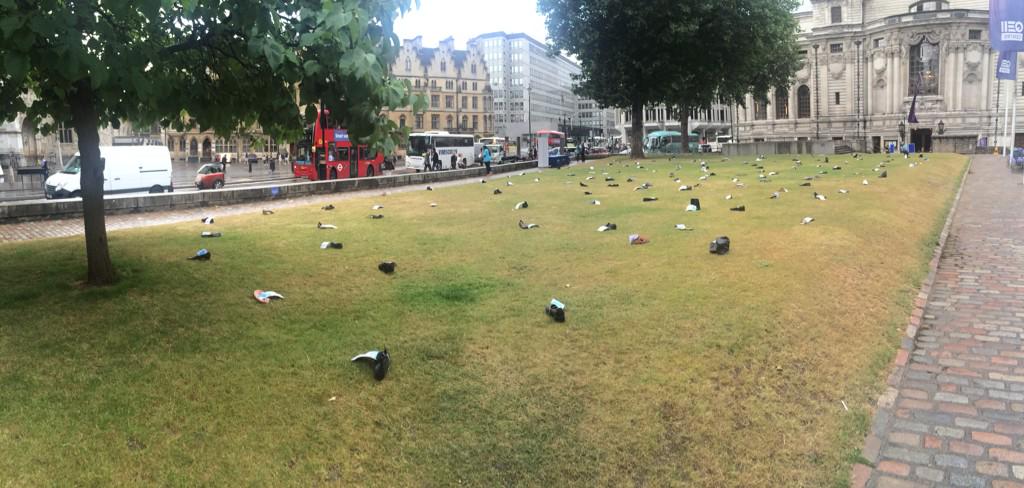
Diabetes UK have been working on their 'Putting Feet First' campaign for some time now, but today is the day they are really trying to hit hard with it. They are staging an event in Westminster featuring 135 shoes scattered across a lawn, each bearing a note of the impact that amputation, or living with the threat of amputation can bring. The statistic is horrifying, but even more gut-wrenching is the byline. Eighty percent of these amputations could have been prevented. Eighty percent. It strikes a particular chord with me as I am aware that Bristol, where I live, has a particularly high rate of amputations compared to the national average.

Having lived with diabetes for over 25 years I have spent quite a lot of time trying not to think about complications, but if you are lucky enough to still have all ten toes attached, just think for a moment about the impact on your every day life of losing one or both of your feet. Of the additional challenges that would come with a million every day moments. Stairs, nipping to the shops, running for the bus, running for pleasure, sports, shoes, paddling in the ocean, walking the dog... And for 108 of those 135 people, this devastating event might have been prevented.

Many of the people who live very real and very human lives behind this cold, hard statistic will be living with Type 2 Diabetes. They will be used to having people assume that this is all their own fault. That they should be ashamed of themselves. That they have only themselves to blame. Because type 2 is a 'lifestyle' disease, right? "Too many cakes and not enough exercise you poor, waddling excuse for a human being". Blah blah blah. So on top of the physical trauma and day to day difficulties faced, they will be heaped upon with guilt for the enormous cost of their treatment to the tax payer. What remains of their self esteem crushed beneath the weight of media, public and family opinion and in some cases even a medical profession that seems to overtly judge them as failures.

But is it really as simple as that? And even if you think it is, what fruit does that mindset bear?

Personally I don't believe that it is. There is a lot in this article, You did NOT eat your way to type 2 diabetes, that makes a lot of sense to me. Now that's not to say that I dismiss the concept of personal responsibility entirely. Of course not. If some people had made changes perhaps they could have dodged their diabetes diagnosis. But it just seems to me that many (most?) people who live with Type 2 diabetes were doing pretty much what everyone else was doing, it was just that their metabolisms weren't up to dealing with the semi-toxic combination of a modern Western diet and a massively wealthy and profit-hungry food industry.

But getting a diagnosis of diabetes (of either type!) surely should not inevitably lead to 135 people each week undergoing expensive life-altering surgery. Our understanding of managing long term conditions, like diabetes, seems to be improving year on year, and yet many of the outcome measures seem to be  getting steadily worse.

How can we change the balance so that there are only 81 shoes on the lawn?

Here are a few thoughts from my unqualified, unmedical viewpoint:

  1. Get your feet checked every year
    This is for us lot with diabetes really. Foot checks are supposed to be part of your annual review every year. Go to your appointment and make sure you get your pulses and sensitivity checked. If there are any problems you want them spotted early.
  2. Stop telling people that diabetes is inevitably progressive
    This is less a factor for us living with Type 1, but many with Type 2 are set up to fail from the outset - if something is inevitable, why bother putting in effort to prevent it? Effective managment of diabetes is a relentless slog, we need to be encouraged that the effort is worth it. Don't blame people if they need more or different medication as time goes on, but never make them feel like it is not worth trying, that there is nothing they can do. Focus more on the positive benefits of effective management in the short and long term.
  3. Stop telling people that type 2 is 'mild'
    Incredibly this still seems to be suggested to some people. That type 2 is not really very serious and doesn't need much attention paid to it. I much prefer the quote about diabetes and tigers: "Living with diabetes is like living with a tiger. If you feed it, groom it, never turn your back on it; you can live with a tiger. If you neglect it; it'll pounce on you and rip you to shreds."
  4. Start telling people to watch their carbs
    Diabetes is a long term condition. People were diagnosed with it years ago, and told the information that was felt appropriate then. Some years ago people diagnosed with type 2 diabetes often significantly increased their 'starchy carb' intake on the advice of their healthcare professionals. Almost all sources now seem to acknowledge that moderating carbohydrate intake - and not just sugar, ALL carbohydrate - is beneficial for people with diabetes. Now I'm not going to open the low-carb can of worms here, because what I am talking about is really more to do with better BG outcomes than any arbitrary label you might place on a number of grams of carb a day that you might feel works for you. Which leads me nicely on to...
  5. Allow motivated patients to check their Blood Glucose
    The vast majority of people living with diabetes in the UK have type 2. And the vast majority of them are told, time and time again, that they do not need to test their blood glucose levels. That the 6-monthly HbA1c test is enough. I could write a long and ranty post about how we seem to have got ourselves into this mess (including the Farmer et al study that is still used as an official reason why SMBG - self monitoring of blood glucose - for type 2 is not recommended) but I would rather talk about the motivated people I see on diabetes forums. They fund their own strips because their surgery won't. They test before and an hour or two after eating something (whenever they generally get their highest reading). They look at the results and the quantities and types of foods eaten and make adjustments. They use the very pre- and post-meal target values that are in the same NICE guideline that denys them access to SMBG. And as a result? They are able to actively tailor their diet to suit their own diabetes, many are able to reduce or emilinate medication and their HbA1cs usually fall well outside of the 'danger zone'. And if they can do it... so can hundreds and thousands more if given the right testing framework, simple guidance and 6 month's or a year's worth of strips for that intensive early testing.

Well done to Diabetes UK for highlighting this important topic. I hope some action can be taken to reduce the enormous, unnecessary, financial and personal cost behind these statistics.

Thursday, 4 June 2015

Release your inner diabetes Hobbit - Guest post for Diabetes UK

My diabetes, yesterday.
Last weekend we finally got around to watching the last part of Peter Jackson's mammoth 'Hobbit' trilogy "The Hobbit: Battle, battle and a bit more battle" on one of those newfangled instant video services (pauses to wistfully remember trawling the aisles of tiny, ramshackle video rental shops all those decades ago). During one of the epic-wide-shot-sweeps across the thundering conflict there emerge, through dust and fracturing hillsides, several enormous, lumbering cave trolls - staggering about, squashing people and generally getting in the way.

They reminded me more than a little of my diabetes.

Except that my diabetes doesn't often wear a little wooden backpack-style platform of Orcs throwing rocks. Although some days...

I think it was the thick-headed stagger of them that made me draw the comparison. The turgid movement. The stupidity and utter disregard for anyone or anything around them. Yup, my diabetes can be all of those things. Slow, stubborn and very hard to work around.

The heroes of the film, by contrast, are tiny, fleet of foot and scamper around very nimbly. Dancing and chasing in and out, between legs and around corners, while the grunting Diabetes Troll laboriously lifts its impossibly-heavy hammer for another ill-aimed swipe.

But there is obvious peril here. Running rings around the hapless troll is all very well, but unless you keep your wits about you, and ideally keep your distance from the 'complications' hammer sooner or later you run the risk of getting squashed.

Mercifully, diabetes complications are pretty slow moving for the most part. And an occasional out-of-range reading here or there does not necessarily mean that our kidneys pack up immediately or our eyes are instantly fried [Good job too looking at my BG results this week!]. But there is a danger in that. It is all too easy to become a little complacent. Doing something now that (you hope) will reduce the chances of *something* not happening 5, 10 or 20 years from now is not a brilliant action-reward feedback loop. What someone once described as, "We work hard so that nothing happens... We hope that all of that "something" we do leads to nothing - Nothing is a pretty lousy reward".

All that effort and nothing to show for it. Are we doing enough? Do we need to do more? And we can't rely on our feelings to measure these things. There are no pain-measuring nerve endings in many of the places that our Diabetes Troll might be taking a swing at. And the swing itself might be so slow as to be almost unnoticeable until it's right there upon you.

And that is why the 15 Healthcare Essentials recommended by Diabetes UK are SO important. The first 9 or 10 represent really important annual checks which allow you to keep an eye on your Diabetes Troll. And if you discover that you are straying a little too close for comfort, having these checks done every year allows you to take action early to reduce your risk of getting squished. Between 10 and 15 there are really important parts of your care package which will allow you to improve your hammer-dodging skills, brush up on your swordplay and make sure your mind, as well as your body are ready for the fight.

15 Healthcare Essentials Checklist

  1. Get your HbA1c measured at least once a year
  2. Have your blood pressure measured and recorded at least once a year
  3. Have your blood fats (such as cholesterol) measured every year
  4. Have your eyes screened for signs of retinopathy every year
  5. Have your feet checked every year
  6. Have your kidney function monitored annually, including having your urine tested for protein
  7. Have your weight checked
  8. Get support if you are a smoker
  9. Receive care planning to meet your individual needs
  10. Attend an education course to help you understand and manage your diabetes
  11. Receive care from a specialist paediatric team if you are a child or young person
  12. Receive high quality care if admitted to hospital
  13. Get information and specialist care if you are planning to have a baby
  14. See specialist diabetes healthcare professionals to help you manage your diabetes
  15. Get emotional and psychological support

Around 80% of the budget spent on treating diabetes in the UK goes on sorting out complications. Just think about that for a moment. 80p out of every pound. All the cost of medications, test strips and fancy diabetes gadgetry are utterly Hobbit-like when set against the monstrous scale of the cost of helping those for whom things have not worked out so well.

The vast majority (around 90%) of people living with either type 1 or type 2 diabetes have never been offered or have never attended a structured education course which could give them the skills to live better with diabetes every day.

Way less than half of the people living with Type 1 in the UK are getting the checks that they should every year. The actual figure, according to the National Diabetes Audit is just over 40%.

People are not finding out early enough that their eyes, kidneys or nerves are starting to show a little wear and tear. It is never too late to make improvements to your own diabetes management, or get the right treatment and support. Many, many people have used information from their 15 Essential Healthcare Checks to dodge the hammer-blow and nimbly dart out of reach of the troll's swing. Early warnings are just that. Improve your diabetes management and in many cases those early signs can be stopped in their tracks - sometimes they can disappear altogether.

If you live with diabetes, or know someone who does - make sure you read that list and make those appointments. Being told, 'It's all looking fine' does not make these visits a complete waste of time. It's an important annual opportunity to make sure you are staying one step ahead of the trolls.

See also: 15 checks, diabetes audits and prawns

Friday, 20 March 2015

Thoughts from the Diabetes UK Professional Conference 2015

I'm a bit late posting this, but I just wanted to jot down a few thoughts following last week's Diabetes UK Professional Conference 2015 (#dpc15). I was, as the saying goes, dead chuffed to be invited to be one of the bloggers/tweeters co-opted onto Diabetes UK's Press Team for the three day conference in London's sunny docklands where the great and the good of the world's diabetes healthcare professionals, researchers and pharma companies gather for a good old chinwag about all things pancreatically challenged.

DPC is one of the biggest events in the global diabetes calendar and patients are not normally allowed to attend for complex reasons involving a Pharmaceutical Industry code of practice (and possibly also so that they can speak fluent doctor-technobabble unhindered and don't have to watch what they are saying about how bloomin' annoying patients are and how the whole business would be much easier without us). However as honourary members of the Press Team we were encouraged to tweet, blog and generally feed information from the conference to the world at large, including you lot.

It was the first time I have been at an event anything like this and it was absolutely huge. Whatever presentation you were attending you got the distinct impression that there were at least six other things running simultaneously that you'd like to be having a look at. Attendance this year was apparently bigger than ever, though #DOC peeps who had been to previous conferences commented that Excel's cavernous spaces made it seem a bit more spread out.

At least as valuable as the presentations themselves seem to be the incidental networking and bumping-into opportunities. Everywhere you went people near you were meeting up, rekindling connections and sharing information. People who have attended more than a few of these conferences must have quite a hard time getting to any sessions at all, because there are so many people to chat with as you move from one place to another.

On a personal level it was great to be able to meet again, or for the first time with so many amazing members of the DOC incuding, Grumps, Annie A, Laura, Sandy, Charlotte, Hannah, John, Annie C, Kath, Roz, Lis, Partha, Pratik, Pete, Neil and others whom I have doubtless forgotten (sorry!). It was also a great privilege to meet with Barbara Young, Chief Executive of Diabetes UK who took time out of her hectic schedule to meet with the bloggers/tweeters and stayed chatting longer than she had intended. She was quite an inspiration, and seemed genuinely interested in listening to feedback and input from the diabetes coal face - about what matters to people with diabetes and their families. Someone commented that Diabetes UK often get a hard time about occasional gaffes, but rarely seem to blow their own trumpet when they do make a positive impact (like here, where they have got the Government to change ther mind about prescription fines). It was only a brief conversation, but it was quite uplifting and I got the feeling that DUK was in very safe hands. It was great too to be able to meet up with representatives of various pharma and device companies that I have bumped into over the last few years to get a feel for any exciting new toys that might be in the pipeline.

Between us, the bloggers/tweeters tried to divide up and 'live tweet' from as many sessions as possible. This proved to be quite a challenge as the talks are short and intensely packed with information, new research data and other interesting snippets. By the time you have tried to compose a phrase which is as close to a quote as you can remember, with or without a photo of the projected slide and then edited for 140 characters, the speaker has chased on at a rate of knots and you are playing catch up.

Here are a few thoughts from some of the sessions I covered, based on the hasty notes I took:

Could intermittent fasting have a role in diabetes management? Michelle Harvie, Manchester
Short answer, yes. For people with type 2 diabetes various intermittent fasting apporaches (eg 5:2) seem to be easier to stick to and more effective for weight loss than continual energy restricted approaches. Fasting days in the research data tended to be approx 650cals and low carb, but results were equally good if low carb but not calorie restricted. For those in whom the approach worked there tended to be an effect on the non-fasting days too. Even though people *could* eat more freely, they did not necessarily do so.

Fermentable carbohydrates: Their role in diabetes management Nicola Guess, London
Not something I'd really heard of, but fermentable carbohydrate (think dietary fibre... pulses... resistant starch... oats...) seem to have promising effect in the context of type 2 diabetes. Results were a little mixed across different studies, not least perhaps because it can be quite hard to evaluate how much FC is in different foods. It may act as a sort of appetite suppressant. When 21g was given as a dietary supplement it resulted in reduced energy intake for the diet of people with Type 2 even if they were not asked to eat less. Fermentable carb was shown to have a positive effect on the phase 1 insulin response of people with type2 and even non diagnosed family members. Insulin sensitivity has been shown to improve in the presence of fermentable carb too. Unfortunately too much fermentable carb can have unfortunate gastric side effects - the gas released from the fermentation of pulses in the gut being an obvious example.

Advancing inpatient diabetes care 5 presentations chaired by Gerry Rayman, Ipswich
This was an extremely data-rich overview from some new JBDS data, including effective new protocols for management of people on corticosteroids and variable rate insulin infusion (sliding scale) in inpatient settings. Also presented a was a huge new piece of research by Norfolk and Norwich Hospitals into nationwide outcomes/detail of DKA management. Some of which was pretty scary stuff - the risk to inpatients with diabetes of experiencing Severe Hypoglycaemia for people with diabetes is 1 in 50 and risk of developing DKA while in hospital is 1 in 200. As alarming as this presentation might have been there was certainly a sense of concerted effort to tackle the challenges of inpatient management of diabetes and establish effective protocols that improve outcomes.

3DFD Integrating Diabetes Care into an individual's world Mary McKinnon Lecture by Carol Gayle and Khalida Ismail, London
I was really taken by this presentation. It outlined a 'three dimensional' model for improving diabetes care by fully integrating clinical, psychological and social approaches. Both type 1 and type 2 diabetes are associated with every major type of psychological disorder, and people with any of these mental health challenges find self-management of this complex and fickle condition additionally challenging. In addition, people living with severe social deprivation are significantly less able to self-manage. Put simply, diabetes is way down on their list of priorities. Address other areas in patients' lives (housing/debt/mental health) and they are released into better self care.

The 3DFD is a short-term intervention with a lasting impact and has moved from an interesting research idea to become a commissioned service in several UK locations. Initially seen as a 'luxury service' it is not only cost-effective, but actually pays for itself several times over in terms of savings made in other areas.

Lessons from the study of hypoglycaemia RD Lawrence Lecture, Rory McCrimmon, Dundee
Some really interesting stuff here about what happens when the body is subjected to repeated mild hypoglycaemia. The exact brain and body chemistry that is at work in the loss of hypo warning signs, and also the loss of counter-regulatory hormone response (epinephrine/glucagon/liver dump). Initially the brain fires all it's warning bells when blood glucose levels drop too low, but soon enough it learns to adapt. Attempting to 'perform better' at those lower levels and not expending the energy of those warning signs. Ultimately though, the brain can no longer function at the lower and lower glucose concentrations that can be reached without warning. Avoidance of hypoglycaemia can reverse this and 'reset the switch', but many struggle with undetected nocturnal hypoglycaemia which sets back their efforts.

Integration of psychologists into paediatric services 3 presentations chaired by Mark Davies
It was really good to see psychological support given so much coverage at the conference. Particularly in relation to children and young people where effective and timely psychological interventions can have such a dramatic effect.

Workshop: Psychological techniques for addressing hypoglycaemia unawareness Nicole de Zoysa and Victoria Francis, London
Great stuff here from the folks behind DAFNE HART, a successful pilot which demonstrates the importance of psychological support in changing people's behavior and understanding of their own relationship with hypoglycaemia. It was particularly good to see the 'compare and contrast' conversation scenarios between healthcare provider and PWD. The difference between people feeling told off/lectured and people being supported to make positive change through responsive listening and motivational interviewing.

Social Media, Why Bother with a Fad? Partha Kar, Annie Cooper, Roz Davies and Laura Cleverly
Great to see social media and peer support getting such a good response at a conference like this. Topics covered ranged from social media in support of nursing practice; tackling isolation and the building of patient communities; and whether social media could be the 'missing part' of someone's diabetes care. Not only that, but Partha Kar opened his talk by suggesting that the term 'non compliant' be removed from the diabetes phrasebook as a result of some social media interactions at the conference. The session ended with a frantic live Tweet Chat and I just hope that some of those who saw the presentations might begin to consider how to integrate social media/peer support into their own practice.

Cognitive decline in people with diabetes 3 presentations chaired by Richard Holt, Southampton
A bit of a mixed bag across these three presentations. Both type 1 and type 2 diabetes seem to associate with 'cognitive decrement' (which I don't like the sound of to be honest), though this only subtle and does not seem to worsen over time. When it comes to type 2 diabetes the Edinburgh study suggests that vascular changes may be the predominant factor. Blood pressuse has little effect, HbA1c has a small effect but smoking has much more of an effect. Overall, improved diabetes management and lack of diabetes complications seem to be a good thing as far as keeping your marbles is concerned. Conversely people with both Alzheimers and T2D are at significantly increased risk of severe hypoglycaemia.

When it comes to young people, there did not seem to be much evidence that mild hypoglycaemia was associated with impaired cognitive function in the long term. Though there may be small risks to very young children who experience severe hypoglycaemia and coma, the brain quickly becomes more resilient in older children and young people.

Hot topics - Diabetes and cardio-vascular risk 4 presentations chaired by Naveed Sattar and Jiten Vora
I was particuarly struck during Miles Fisher's presentation about assessing cardio-vascular risk in people with diabetes when he described the decision to recommend statins for the primary prevention of CVD in people with type 1 diabetes as an 'OBSAT' decision. With a twinkle in his eye he explained the acronym as 'old boys sat around a table'. He suggested that the research evidence did not support the recommendation and that there was a risk of 'over medicalising' the population. His opinion was that the presence of micro-abuminuria was a more reliable marker for prescribing statins for primary prevention in T1D.

In general terms intensively managing blood glucose levels, the earlier the better, significantly protects against CHD for people with diabetes.

Physical activity and Type 1 3 presentations chaired by Jason Gill, Glasgow
This was my last session of the conference and the one that provoked perhaps the greatest interest on Twitter. One of the slides in Rob Andrew's presentation showed a flow chart which seemed to contradict itself. Beamed off into the ether without the explanatory dialogue many people responded, "Ehhhhhhh?!" but the presentation had moved on apace. A lesson learned perhaps in the perils of trying to share complex ideas in 140 characters at speed. There was a lot of detail from Rob Andrew about managing exercise and type 1 diabetes, you can find more information here when the site launches soon. Some interesting snippets too from Richard Bracken about bone strength in T1D. I had not realised that type 1 was associated with an increased risk of fractures, but it seems that resistance training can help improve bone condition and strength.

Summary
On the whole I was really encouraged by the conference programme, and by the tangible sense of passion and commitment from those working in the field who are aiming for better outcomes and more personalised care for people with diabetes. Huge thanks to Diabetes UK for inviting me to be a part of the event.

Disclosure: My travel, accommodation and entry to the conference were paid for by Diabetes UK. I was not paid to write this post or any tweets relating to #DPC15.

Saturday, 11 October 2014

15 Checks, Diabetes Audits and Prawns

Last week saw the publication of the National Diabetes Audit (NDA) for 2012-2013. It's a bit like Ofsted for diabetes clinics and includes results for just over 70% of the places providing care for people with Type 1 and Type 2 diabetes in England and Wales. If you want to dig into the vast and weighty documents yourself, they are published online here: www.hscic.gov.uk/nda.

I got as far as skimming Report 1 'Care Processes and Treatment Targets' (check out that horrendous BG testing technique on the cover folks... right into the nerve-ending-packed softness of the fingertip! Use the sides people use the sides) before one of the stats just jumped out and hit me between the eyes.

Way less than half of all Type 1s are getting the routine healthcare checks they should.

40%. Forty. Percent.

My daughter reliably informs me that in GCSE terms that comes out as an 'E'.

The actual figure is quoted as 41.3% and it has been falling since 2010. That's almost a quarter of a million people living with type 1 diabetes who are missing even the most basic annual checks to help them keep on track.

When it comes to actively supporting people to manage their condition effectively by offering them some sort of structured education course the stats are even more eyewatering. Less that 4% of people being offered a place on a course. A measly 1% actually make it onto the courses. There's a lengthy rant right there... but that will have to wait for another day.

Diabetes UK lists 15 healthcare essentials that people with diabetes should get each year:
  1. Get your HbA1c measured at least once a year
  2. Have your blood pressure measured and recorded at least once a year
  3. Have your blood fats (such as cholesterol) measured every year
  4. Have your eyes screened for signs of retinopathy every year*
  5. Have your feet checked
  6. Have your kidney function monitored annually
  7. Have your urine tested for protein each year
  8. Have your weight checked
  9. Get support if you are a smoker
  10. Receive care planning to meet your individual needs
  11. Attend an education course to help you understand and manage your diabetes
  12. Receive care from a specialist paediatric team if you are a child or young person
  13. Receive high quality care if admitted to hospital
  14. Get information and specialist care if you are planning to have a baby
  15. See specialist diabetes healthcare professionals to help you manage your diabetes
  16. Get emotional and psychological support

* eye screening is now handled separately and bizarrely is no longer included in the NDA


The ones in bold are the checks that are covered by the NDA. Eight or nine routine measures to check that nothing nasty is lurking, and to be able to do something about it if things are going awry. These checks are not about passing or failing - they are about protecting us.

So what is going on?
Is it just people not showing up?
Is it that the appointments are not available at convenient times?
Is it that people simply do not *know* that these simple routine checks are so very important?
Is it a lack of resources?
Overstretched NHS?
Un-engaged individuals?
Are clinics not helping patients?
Or are patients not helping themselves?

My guess is that it is *all* of those things.

I wrote once before about the exponential rise in the number of appointments that were involved in my 'annual review' and the situation is much the same. Decentralised care may work well as a buzz word, but patients have ended up with 4 or 5 appointments instead of 1, which makes the whole process much more of a faff.

But here's the harsh truth.

Faff or not - if you are living with type 1 diabetes you need to do whatever you can to make sure that you get those checks.

They are not for the benefit of the doctors. They are not for the purposes of making someone's spreadsheet look snazzier. They are for YOU. We live in a world where people struggle to get access to any insulin at all - let alone the particular type and/or colour of pen that they prefer. The very least we can do is turn up for (free!) appointments designed to help us to make it through life with our feet on and our eyes working.

It absolutely appalls me that the figures are what they are. And the people most likely to suffer as a result are not the clinics or doctors, but the very people who are not getting checked.

Yes I'm sure some clinics could help with more flexible appointment times. Some employers might need to be reminded that under the DDA (or whatever it is called this week) they need to make 'reasonable adjustments' to support employees with diabetes in keeping these kind of routine healthcare appointments.

But at the end of the day we have to find ways of attending.

Prawns
Perhaps it would be easier if diabetes was a bit more like prawns.

After 25-odd years I am very glad that diabetes is often a relatively slow-moving adversary. But perhaps part of the problem with all those thousands of appointments from the patient perspective is that diabetes is not enough like prawns.

Perhaps it's not prawns for you. Maybe it's peanuts. Or yoghurt. Or fresh ravioli with ricotta.

When I was in my teens I had an absolutely delicious pub meal out while on holiday. I chose a local speciality of prawns in their shells. They were fabulous. On the way home in the car I began to feel a little uneasy. I used to suffer a little with motion-sickness so put it down to that. I still felt a bit odd and over-full at bedtime. But then... we had eaten rather a lot. I woke with a start in the early hours and knew instantly that things were not right. Not right at all. Somehow I managed to stumble, in the dark, with excruciating urgency to the tiny the bathroom where I remained until the following morning in a wretched, heaving heap.

I still struggle to look at a prawn.

The trouble is there is no such immediate come-back for a missed appointment here or there. Eating a big ole serving of 'not enough time at the moment' prawns in 'missed appointment' sauce doesn't bring me out in a sweat just thinking about it. But the results of missing those checks are potentially even more catastrophic.

80% of the NHS budget that is spent on diabetes goes on treating complications. We owe it to ourselves to do what we can to change that statistic. To beat diabetes one day at a time. To keep ourselves well.

Making sure we get all our routine healthcare checks is a tiny step in the right direction.

Friday, 18 July 2014

Speed boats and oil tankers - Guest post for Diabetes UK

My ups and downs have been a little more up and down of late (read for most of this year, it's still early Spring, right?). Not exactly disastrous, but I've not really managed to ever get things into any kind of groove for more than a week at a time. A bit wearying to say the least.

Part of me knows the best way to improve things is to go back to basics and do some fasting basal tests and tweak my basal profiles based on actual information rather than the (un)educated guesswork I've been relying on for a while. Another part of me is having enormous difficulty summoning up any enthusiasm, since I know that the summer holidays are coming and I'm likely to stop going to the gym for a couple of months which will have a knock-on effect in itself.

So I'm spending my time grumbling and hurrumphing instead (my family are so lucky!).

On the plus side it does give me a chance to jot down this analogy that I've been meaning to for some time. It's something that usually strikes me when my BG levels are a bit errant, and insulin and food are just not playing nicely.

When it comes to trying to balance the effects of food and insulin on blood glucose levels (well and everything else.. but specifically food and insulin), one thing that makes it very tricky is the difference in the speed of action of carbohydrate and insulin. It's not enough to accurately match the dose of insulin to the amount of carbohydrate you are eating - you have to try to ensure that the two act more or less together to reduce BG wobbliness (technical term).

Almost all carbohydrate is very much in the speedboat class. Fans of glycaemic index tables (GI) might agonise over whether something is high GI, medium GI or low GI, but in my experience the differences equate to something being 'almost instantaneous', 'really very fast indeed' or only 'very fast'. Not a great deal of protection against the ravages of a post-meal spike, either physiologically, or that emotional kick in the guts of seeing your levels rise from a decent pre-meal number well into double figures an hour or so later. From the very first mouthful those big outboards start roaring and the carbs go zipping and zooming about, gleefully spraying glucose in their wake.

Insulin, on the other hand - even the fancy schmancy 'rapid acting' analogues can seem painfully slow to get going. More like one of those behemothic oil tankers or container ships. With a great groaning and clanking, the thrum of the plunger on an insulin pen or pump delivers the dose and then... Nothing. Watch and wait. Is it an illusion? Is it actually moving yet? Nope. Still can't see anything happening.

Vooooom! Swish! The carbs go tearing past again. Running rings around the slumbering giant.

This is particularly the case for me when I am waiting for a correction dose to kick in. I've had to stop myself from checking post-correction BGs before an hour has elapsed. Any less than that and the chances are my BG will be almost unchanged. An hour! Thanks Novo Turgid - not exactly breakneck.

Of course... one of the things about an oil tanker is that once it is moving, there's not a lot you can do about it. All those stories about them needing however many hundred nautical miles to slow down or turn a corner. And so it can feel with rapid insulins.

Nothing... nothing... nothing... Ah good, movement! Good... All good, back into range. Right that's enough now thanks... STOOOOOOOOOP!

But on and on, the dose lumbers forward - an unstoppable force. All-ahead full. The tanker has now run straight over those speedboats crushing them to matchwood and we could very well be steering directly toward Port Hypo.

Corrections can be a tricky course to navigate. Artoo tries to help by offering a suggestion of 'Active insulin' - how much dose is still working away, but there are *many* variables to factor into that equation. Sadly I find Artoo's attempts to be the vaguest of indications at best, and often wildly inappropriate to the particular circumstances of the moment.

Patience is the skill I have to master. I am always trying to remind myself that while the spike in my blood glucose levels may have happened in only 45 minutes or so, the insulin correction will only have stopped after something like 4 or 5 hours. If I get impatient and overcorrect in the meantime I am likely to cause myself another problem (and more wobbles) by overdoing it.

Aye aye, Cap'n.

Wednesday, 25 June 2014

Hands up who thinks kids with diabetes deserve decent care and support in schools

I was diagnosed at 21, during the final year of my degree. Not perfect timing I suppose, but I recognise that I had it a whole LOT easier than the thousands of kids who are diagnosed at a very young age and who have to try to balance life with type 1 diabetes alongside the unpredictability, raging hormones, growth spurts and peer pressure of school life.

I. Cannot. Imagine. It.

So hats off to Diabetes UK for their 'Make the Grade' campaign which aims to improve the support offered to children with diabetes in schools.

If you'd like to find out a little about what they are doing and why it is so important, they have produced a nifty piece of You-Tubery here:

Tuesday, 10 June 2014

The "I can..." of insulin pumps - Diabetes Week 2014

The theme of this year's Diabetes Week is 'I can...'. Here's a guest post I was invited to write for the Diabetes UK blog.

When I was thinking about this year's theme of 'I can' I was reminded of a conversation I had with someone last week about insulin pumps. It was something that they were being encouraged to consider, but like pretty much everyone else (myself included) their initial reaction was uncertainty. Uncertainty over being connected to something 24 hours a day. Uncertainty about relying on a fragile piece of technology to keep them alive. Uncertainty about how it would make them feel and how others might view them. Uncertainty over whether it would actually improve anything at all. In short, they didn't really think it was for them.

I know those feelings well. I had them all, and many more besides. I was 'pump averse' for many years. My clinic suggested that it might help with my recurrent hypoglycaemia, but could never really articulate how that might happen. All I could see was a big bunch of (what I thought were) downsides.

In the end, for me, it was reading the experiences of pump users online that convinced me to give it a go. The day to day nitty gritty of how it helped them. Now I'm not saying that insulin pumps are for everyone. Some people wouldn't want to touch one with a barge pole, others do just fine on Multiple Daily Injections and are completely happy as they are. But if it is something you are considering, here are a few 'I can's that an insulin pump has given me to add to your thinking:

If I want to go to bed at 5.0mmol/L, I can.
Ahhhhh basal! I have been through quite a few basal insulins in my 25 years of pancreas-impersonation. In the old days we were always advised to have a snack before bed. Why? Well because in all likelihood your basal-du-jour was going to be a bit over-enthusiastic in the early hours and could well plunge you into an overnight hypo. It was many years before I discovered 'basal testing' (systematically adjusting your basal insulin by fasting tests so that it just holds you steady) but try as I might, even with fancy schmancy analogues I could only ever get my basal 'near enough' on MDI. A bit too much here, not quite enough there... make up the differences with meal doses and guesswork. With a pump, the flexibility of multiple basal patterns which can be tweaked and changed with almost infinite precision mean that I can adjust things so that I am actually starting from a level playing field. To my mind, basal is the bedrock of my BG levels. If my basal is out, even by just a little bit, my meal doses and corrections just do not play fair. So I no longer have to worry about stocking up on carbs before bed, because my basal insulin should hold me level and when I need less insulin overnight I get less. Where I need more just before breakfast, I get more.

If I want to give a really accurate dose, I can.

My doses on MDI were often a bit 'ballpark' to be honest. I have always counted carbs and altered my doses based on what I am eating, but I usually rounded up or rounded down to make things easy. Plus I would use insulin:carbohydrate ratios that meant I didn't have to get a calculator out all the time. The Accu-chek Expert was a great tool on MDI for tweaking doses, but I was still using a 'whole unit' pen so there was a degree of rounding even then. Now I can bolus in decimal places. And those tiny tweaks of insulin here or there do seem to make a difference. True enough my carb estimates are still often done by eye, but at least one part of the puzzle is now being calculated and delivered precisely.

If I want to stop here for lunch, I can.
This was the biggest surprise for me. Rediscovering spontaneity. I began pumping with an fairly entrenched anxiety about being hooked up to something 24/7. I know almost no one who has not had that when considering an insulin pump. Many people say that within a few weeks (days for some people) they become completely at one with their new robot pancreas and never give it a second thought. I can't say that it was quite so quick for me, but certainly in less than six months I had stopped noticing being attached at all and my emerging 'unthought' behaviours (like automatically hooking it to a t-shirt when getting changed) meant I never really gave Artoo another thought. If you are newly on an insulin pump and it still feels a bit of a nuisance or 'in the way' hang in there. Where was I? Oh yes... Spontaneity. So I was well prepared to dislike being attached, but I really hadn't expected that attachment would turn out to be such a bonus. Out on a wander on holiday... get a bit distracted and it takes rather longer than anticipated... Oh this pub looks nice, shall we stop for lunch? What would have always previously been "No we can't, I didn't bring my pens with me" has simply become "Yes!". Wherever we are now I always have my 'kit' with me, and while I used to like the idea of being able to leave all this stuff on a table and just walk around 'like a normal person', personally I have come to realise that I feel much more 'normal' if I can eat whatever I fancy whenever I want to, without having to remember to bring a case full of gubbins with me everywhere.

If I want to have 20 boluses/corrections/snacks in a day, I can.
Well strictly speaking I always could have, of course. But in reality I never did. There is something so easy and effortless about push-button dosing that I am far more likely to add in a fraction of a unit here or there during a day when I recognise that I probably wouldn't have bothered to get a pen out, airshot, dial up and inject. This has increased freedom around snacks too. Where I previously found them just to be too much of a hassle on MDI, almost always resulting is a BG wobble in one direction or other (depending on whether I had bothered to bolus or not) I've had much more success with the effortless mini-doses a pump offers. It's easier, so I bother to do it.

If I want to run a marathon (or just vacuum the stairs), I can.
Again, this was something I more or less tamed with MDI, but the additional options available on a pump, like the ability to set a 'temporary basal rate' for several hours, have added considerable 'polish' to many of those day-to-day conundrums of physical activity. I am far less likely to see my BG levels dip below my target range when exercising these days and I'm buying far less Lucozade!


Just a few things of the top of my head. I'm sure most people on pumps could write their own list. Of course diabetes is still annoying and frustrating quite a lot of the time. A pump is not a magic bullet and it still involves a fair bit of faffing about. But for me having a pump has made a tighter set of BG levels more possible, with less effort and far, far fewer nasty lows.

If you are struggling with wrestling your diabetes into some sort of submission and have been offered a pump as a possible way forward I'd suggest giving it a go.

If I can do it... You can.

Monday, 14 April 2014

Diabetes Speed Dating Clinic Type Thing

Some months ago I found myself looking back over the past few years.

If you've read our blog before (congratulations on your uncommon stick-ability) you may remember that we began writing about my diabetes as a family as a result of an unusually nasty hypo. One which made me question whether I was quite as competent at managing my diabetes as I liked to think I was. Posts from others in the household have dwindled rather, and you've ended up stuck with me. Sorry about that. But I look back over the past few years and realise that I have been on a full-on misty-eyed X-Factor-Strictly-Voice-finallist 'journey'.

I was reminded about this yesterday while reading a blog post by The Grumpy Pumper about his own story of venturing into the Diabetes Online Community (DOC). I have had similar conversations with Dave (@SowerBee) previously too.

It seems to go something like this...

  1. Get diagnosed
  2. Learn to muddle along in your own way, with varying degrees of success
  3. Never, or almost never, meet or speak to another actual real-life person with diabetes
  4. Feel slightly isolated and faintly dissatisfied with how you are doing but don't know what to do about it
  5. Lose a bit of faith in suggestions made by various healthcare professionals/clinics/consultants/registrars/DSNs (what do *they* know - they don't live with this day-to-day, harrumph etc)
  6. Carry on for 5/10/15/20 years
  7. *Something* happens
  8. Look for support online and/or meet other PWD face-to-face (eg on DAFNE)
  9. Lightbulb moments ensue
  10. Engage, share, try new strategies, feel empowered
  11. Understanding and management of condition is transformed

Now here's the thing.

This is a pattern I see repeating, time and time again in the experiences of others just as it did with me.

But there are still so many people at point 5 or 6. People for whom the standard structure of clinic appointments just isn't quite working, but who either don't realise that 'peer support' like the DOC exists, or who would run a mile from the very idea of it, believing that it is 'not for them'. I know the second group well. I was a fully paid-up member for all the years that deep-down in my heart I knew I was struggling a little, but made myself believe that 'this was as good as could be expected' and 'nothing works'. Of the 300,000 people living with Type 1 in the UK how many are connected with others? 3,000? 10,000? That still leaves the vast majority 'soldiering on' on their own with only an Annual Review for company.

So what can we do for them?

Don't get me wrong. I'm not saying that peer support could fully replace 'proper' consultations with qualified and well-trained healthcare professionals. I am aware that dark, weird and scary corners of the internet exist, where all sorts of odd ideas are bandied about as fact (though these are hard to maintain in well-populated, mixed groups and in my experience the DOC doesn't stand for nonsense). But I'm also aware that there is nothing quite like hearing experiences of someone in your position, who does live with the same condition as you every day. Who faces the same struggles and has tried strategies that you might consider.

I've also spotted another phenomenon. If you attend a 'meet up' of forum posters, bloggers, tweeters or others who live with diabetes you will not be able to get them to shut up. In fact, you will struggle to get a word in edgeways. Questions will be asked, approaches and strategies compared, support offered, understanding and empathy for the sheer relentlessness of it all given freely.

I'm also aware that every day, up and down the land, dozens of people sit side-by-side with other people with diabetes in stony silence.

And this strikes me as odd. Or at the very least a massive missed opportunity.

I've been meaning to write this post for months, but kept putting it off because I could never quite get my head around the details. To be honest I couldn't even work out a proper title for the post (this you will have noticed). But the time has come to just 'put it out there' to see if some brave Consultant or Clinical Lead can do something with it. Someone like Partha perhaps?

Here it is: Wouldn't it be great if there was a way to harness all those wasted minutes in the waiting rooms at diabetes clinics. If there was some way of facilitating peer discussion and support while we are all sat there waiting for our number to come up. At the very least it might prompt some actual questions to ask in the appointment itself, rather than everyone just sullenly descending into smile-grunt-nod territory.

Something a bit like speed-dating. Sit opposite a person or two for 5 minutes, ask them how they are getting on. How long they have had diabetes. Is there anything they particularly struggle with. Do they have the same problem I do with this or that? What do they do about it? Ring a bell, everyone moves around... 'You'll never guess what that last bloke said...' 'Really? Oh I get that too...'

Of course there would have to be some sort of 'opt out' for people who simply can't face the idea. But I'd love it if we could break the unwritten rule in diabetes clinic waiting rooms that 'thou shalt not say anything to anyone'. For people to be actively encouraged to compare experiences and support each other. So that each clinic appointment would combine the very best of both D-meetups and HCP input.

If that was on offer - would you join in?

Thursday, 13 March 2014

Why I decided to stop being ‘a diabetic’ - Guest post for DiabetesUK

Words are powerful things.

I had a very interesting conversation with the very lovely Lesley Jordan of INPUT in October last year which made me focus on something I had been mulling over for some time.

It’s odd, because I’ve seen it discussed online and in social media before, often with a level of passion and sometimes outrage that has made me think, ‘Why are you letting yourself get so wound up about that?’

I think it began to make more sense to me when I considered the subject in the light of the way I think about my own diabetes, rather than the words or terms other people might use in conversation or in the media. I think to get too stressed or riled up about what other people say is counterproductive, but I have come to see that it is very important for me to choose my words carefully for the little voice in my head.

I know, I know. Many of you are rolling your eyes, and someone almost certainly just said ‘Oh good GRIEF!’. But bear with me here...

Living with a long term condition like diabetes is hard work. There will be days when you might just breeze along quite happily, barely giving it a second thought, but there will almost certainly be other times when it is a lonely, grim and gruelling marathon – and everything is up hill. It is well established that diabetes and depression often go hand in hand and it is important that we protect ourselves and our sometimes fragile senses of self-esteem. One of the most successful ways of doing this seems to be ‘cognitive behaviour therapy’ (CBT) and an important CBT technique is to adjust your inner voice to help you see situations more clearly and more positively.

I think in words. Conversations with myself. In all the countless interactions I have every day with my diabetes I hear my inner voice commenting on what I am doing. If I am not careful, the background to my every day can become a relentless tide of negativity and judgement.

“I have to test my blood...”
“My control is *terrible* at the moment, my BGs have been really bad...”
“Well I really messed up that carb count there. I should have weighed it, I bet I go hypo later...”

And all of this spills over into any conversations I have with other people too.

So I have been trying to make tiny changes to the language I use with myself and with others when I talk about my diabetes. These seem so tiny and insignificant that it is hard to believe that they could matter at all, but we have a rich and subtle language and every word we choose conveys complex messages to those around us and to our own subconscious.

So now I am no longer saying I am ‘a diabetic’ – a label which defines me, instead I am a ‘person with diabetes’ – person first, diabetes second.

I am trying not to think about ‘good’ or ‘bad’ blood glucose or HbA1c results. Instead I think of them as being ‘in range’ or a ‘work in progress’.

If you ‘test’ your blood glucose then you can pass or fail that test, so it is better to ‘check’ or ‘measure’ your blood glucose. Check your blood glucose level to give you information about what to do next. Check, respond, move on.

Don’t try to ‘control’ your diabetes, ‘manage’ it instead – there are often factors that affect your blood glucose levels that are outside of your direct control (an unexpected liver dump or some other diabetes randomness), but you can use your skills and knowledge to manage those changing circumstances as best you can.

Even terms like ‘should do’ or ‘should have’ can imply some sort of personal failure if something doesn’t quite go to plan. ‘Can do’ and ‘will do’ are more positive alternatives.

There are also changes you can make in the way you think about food, and talk about it with other people. ‘I can’t eat that’ implies that I am being prevented from doing something and that I’m not in control of the decision. ‘I am not going to eat that, because reducing my carb intake makes my diabetes easier to manage’ or even simply ‘I don’t eat that’ puts me back in control – I am making a choice at that moment and I know why I am making it. Next time I can choose again, perhaps differently, but it is always my choice.

As I say, these changes are tiny. It is hard to believe that they would have any effect at all, but little by little they are helping me engage with my diabetes in a more positive way.

What helps you stay positive?

Thursday, 26 September 2013

Does social media empower patients or confuse them?

That was the question posed at an event held by Brandcast Media as part of Social Media Week London yesterday (no, me neither). I was chuffed to be invited to attend by Diabetes UK whose 'Digital Engagement Executive' the irrepressibly perky Amy Burton was speaking on the panel. Alongside her were George du Toit a Paediatric Allergy Consultant, Andrew Schorr 2x cancer survivor & founder of Patient Power and Sneh Khemka, Chief Operating Officer of Advanced Oncotherapy. Charlie Grieve, Brandcast's CEO holding the reins and gently steered the conversation.

When I arrived at Brandcast's groovy offices just off Regent Street the room was already filling up with a heady mix of cool and confident Social Meeja types, healthcare professionals and charity representatives. By the time the discussion started it was standing room only. I found a quiet spot and spent a few moments debating whether to avail myself of the funky Moleskine-esque notebook in Brandcast's signature bright pink. I gave Amy some encouraging smiles and nods.

What followed was a fascinating conversation about the impact of Social Media on patient experience. Almost inevitably the event was live streamed, and heavily tweeted under #smwdigitalhealth. Andrew Schorr gave a powerful account of his own experience, where the information and confidence he received through social media interactions led to him receiving completely different care, without which he quite probably would have died - "Social Media saved my life". Here are a few other snippets that stood out to me during the course of the evening:

"I have not a doubt in my mind that social media is empowering patients. But you need to know where to look/where not to look" Sneh Khemka

"Different people value and need different Social Media channels - everyone finds their own niche" Amy Burton

"Medics are, by and large, cautious of social medial" George du Toit

"Patients who share a diagnosis can push for therapies or question the use/effectiveness of certain drugs by working together" Andrew Schorr

"Some social media platforms are becoming the Trip Adviser of hospitals. Patients can assess the quality of their own care" Sneh Khemka

"HCPs need training in use and governance of Social Media" George du Toit

"What one change would I like to see? For more HCPs to engage with online communities" Amy Burton

As expected there were some concerns raised over the nature of some of the 'advice' in circulation in the FaceBlogTwit-o-sphere, over privacy and the potential (mis)use of data shared over social media, some of which can be quite staggeringly personal and sensitive. The general feeling though was that patients are making their own individual decisions about what they share with whom - and many of the online communities (from my perspective I would say particularly the DOC) are quite good at self-regulation, suspicious of 'miracle cure' nonsense and take all content with a healthy pinch of low-sodium condiment.

I suspect that quite a few in the audience were interested in gaining insight into how to 'leverage' social media channels (sorry, terrible industry phrase) on behalf of healthcare clients, private health providers and Big Pharma, it was encouraging then, that the panel recognised the crucial nature of transparency in these interactions. These online communities exist and are powerfully helping patients, but they are savvy, often fiercely independent and quite naturally suspicious of commercial interference. They will very quickly smell a social media rat if businesses come rampaging in with a clumsy marketing agenda.

It was great to hear the two healthcare professionals on the panel speaking so enthusiastically about their own use of social media in clinical settings (which seems to be on the increase as newly qualified HCPs come through who are already engaged in social media). Additionally there were some tantalising some glimpses of what might be coming next. For instance I had not heard of 'Watson' a computer system that is, apparently, better at diagnosing cancer than many doctors because it uses a constantly-updated database of research and evidence rather than relying on what it can remember from medical school and what Dr Sheh described as 'your own experience, prejudices and preconceptions'. What we need, he suggested, was the computer to number-crunch the data and evaluate the most likely diagnosis based on all the available evidence but then a sensitive, compassionate medical professional to interpret/relay that diagnosis in the light of the individual person in front of them.

The final question for the panellists was, 'What one change would you like to see?'. Half the panel wanted to see more involvement from healthcare professionals in social media communities, while Sneh Khemka rather pragmatically suggested that giving interactions/consultations over social media some sort of tariff so that healthcare professionals would come to see them as 'proper' earning work would be a sure-fire way to drive that.

We shall see!

Disclosure and all that. I wasn't paid to blog about this or attend the event. Diabetes UK kindly paid my train fare and Brandcast Media gave me a nice bottle of beer and some tasty nibbles at the end of the event. I decided against taking the notebook.

Monday, 10 June 2013

Diabetes Week - Artificial Pancreas Project

It's Diabetes Week in the UK this week and after my rather forlorn post about the apparent disappearance of C8 medisensors non-invasive CGM last week I was pleased to read this little update on the Artificial Pancreas Project (APP) from Diabetes UK today.

It's still reasonably early days, and to my mind we are still quite a way off a 'real' management solution, but step by step people are cautiously being allowed to hand over the reins overnight to an automated system in their own home rather than under strict lab conditions with technicians standing by the bedside clutching Lucozade and NovoPens.

For those of you who have *no* idea what I am going on about, the Artificial Pancreas Project is seeking to 'close the loop' between two clever bits of diabetes kit. A Continuous Glucose Monitor (CGM) that can measure glucose levels and an insulin pump that can provide varying doses of insulin. In fact most people who happen to see my pump tend to assume that we are there already, and assume that a pump will just somehow 'know' how much insulin is needed and provide it automatically. Sadly it's not quite that easy, and while an insulin pump is a brilliant therapy option it does still require a fair amount of effort, guesswork and to be honest more than a little luck in balancing all of the hundreds of variables involved in day-to-day BG tomfoolery.

Part of the problem with the APP of course is that the technologies involved are improving, but still rather less than perfect. Continuous Glucose Monitors make an estimate of blood glucose levels based on glucose concentration in interstitial fluid (the stuff sloshing around between cells in tissue). This tends to lag a bit behind actual BG values, and those lucky enough to have access to CGM will know that what you are really getting is 'trend' information rather than the accuracy* of blood-based fingersticks. CGM manuals/marketing are usually pretty clear that any doses/corrections made should be done after confirming results with a fingerstick test. But the closed loop system needs to use this very same stream of trend information in order to make dosing decisions.

Currently the human trials of the APP are showing relatively promising results for looking after things overnight. To know that you had a smart system carefully tweaking your levels while you slumbered would be fantastic, but of course a full Artificial Pancreas would have to go much further and tackle the thorny issue of mealtimes. Personally I think we are a looooong way off that. For one thing current 'rapid' analogue insulins are hopelessly inadequate for the task. They take far too long to get going (1 hour for corrections to start taking effect anyone?) and act over far too long a time period to give a bunch of electronics, however smart, the ability to take over entirely.

What I would hope for instead is a commercially viable 'smart pump' which combines much of the effort and user knowledge/experience that currently goes into effective pump use, but with automated AP trickery to take the edges off the errors and irritations of daily pancreas impersonation. A system whereby you would bolus for meals, set TBRs for activity and generally do the basics, but the pump would be constantly monitoring how things were going and have the ability to tweak things and make corrections to keep things on a more even keel.

Now that really would be something.


* It should be noted, of course, that fingerstick BG tests in themselves are not particularly accurate and only really serve as a general guide as to what is going on.

Friday, 3 May 2013

Running. Battles.

It's been a busy old time recently, and updates on the blog have taken rather a back seat. Sorry about that!

I realised this week (on Monday in fact) that I had not yet even managed to post an update following my Half Marathon shenanigans in Bath exactly two months ago today. Shocking!

Part of the reason for this post is to say an ENORMOUS thank you to everyone who donated so very generously in support of my race charity Diabetes UK, in fact your generosity was so apparent that I was also able to donate to Medical Detection Dogs (the tiny charity that is able to specially train clever pooches to sniff out hypos and hypers). In total you raised the mighty sum of £685.50, you should feel very proud of yourselves, you rock!


Ready for the off at the Bath Half 2013
I had a great time on the day itself. It was bitterly cold at the start where everyone stood shivering for about an hour, but the mood was very cheery nevertheless. It was my first distance race of any kind, and I think I had naively underestimated the experience of running among something like 11,000 other people. It took much longer than I'd thought to find space enough to run at my 'own' pace. I was able to finish the 21km (13ish miles) in 1hr 46 mins, which is just about as fast as I ever thought I'd be able to do it.

I think the D fairy must have been having a day off that day, as my levels were bewilderingly good. The race started at 11am, but even so I reduced my breakfast dose to 90% of normal. Thanks to Artoo I was able to set a TBR which took my basal down to 10% an hour before the start and throughout the run. My levels on the day looked a little like this:

3.00am - 7.3
8.00am - 7.5 Breakfast
9.30am - 7.9 waiting to start
1.00pm - 7.0 Finish! I downed a 60g CHO bottle of lucozade on the way round
2.51pm - 6.8 Lunch

To say I was pleased with those is a bit of an understatement! I wondered at the time if perhaps I should run a half marathon every day?

As is the way of things, it has taken me a fair old while to get the last few donations collected, but the cheques are now on their way to the respective charities. Immediately after the race I'd found myself reflecting on the unexpected enjoyment I'd found in the training, but thought I wouldn't hurry to take part in another event. Then a *very* odd thing happened. Last Sunday was the London Marathon, and I actually found myself thinking, "Well... I wonder if I could...". Encouraged by Dave and his tangerine enthusiasm I have unexpectedly put my name forward for the 2014 ballot. The chances of making it into the event are pretty slim - but it would be an interesting challenge!

The rest of March and April have been a bit of a mixed-bag levels wise. March, and Easter in particular involved quite a few family get togethers and celebration meals which are always fraught with guesswork and wild stab-in-the-dark boluses with all the (lack of) success you might expect. April looked to be a little more settled in patches, but by the end of it a few chaotic days had worn me down, wrecked my averages and SD and I ended the month feeling quite grumpy about the whole unrelentingly inconsistent business.

Part of me thinks I am pushing myself too hard and need to learn to be happier with the successes I am seeing rather than contantly reaching for those elusive 'perfect' days. Many people who have lived with Type 1 Diabetes for any length of time will be familiar with that feeling I think.

I've decided it's time to run a few basal tests during the day just to make sure there is nothing obviously wonky on that score. A tiny dip below 4.0 after the gym has put paid to that for today. Ah well.

Enjoy your Bank Holiday everyone!

Wednesday, 27 June 2012

Face to face

Not so very long ago I would have run an absolute mile if someone had suggested getting together with other people with diabetes.

Biscuits and smalltalk among a group whose only common factor is a condition we all wish we didn't have? Er, no thanks. Death by PowerPoint covering "What food I think you shouldn't be eating" by someone who hasn't been living with my diabetes for 20 odd years. Hmmmm.

But the times, as Mr Zimmerman is keen to point out, are apt to change.

Yesterday I spent a very pleasant evening at the Bristol County Sports Club with a dozen or so others considering whether it might be quite nice to have a support group in the centre of Bristol. The fine folks in the regional office of DUK South West have people whose job it is to see if they can't get us all together once in a while and a new group in the city centre is being considered.

Having spent nearly 20 years flying solo as a diabetic, this blog pretty much covers the period during which I have begun to compare notes with others, both here, on a variety of forums and by extension, at occasional get togethers in real actual living and breathing life. The very thing that I would have run from for all those years has become a very real source of support, encouragement and information - both online and in person.

Earlier this month I wrote a guest post for Diabetes UK as part of Diabetes Week in the UK about the huge value (and frustration) of making very different sorts of diabetic connections. If you are still flying solo I encourage you to seek out some diabetic connections of your own - either online or in person.

What I found interesting last night was that although there were, I think, rather fewer there than the organisers had hoped for, we pretty much managed to cover all the bases diabetically-speaking: Two healthcare professionals, several type 1s, several type 2s, a couple of representatives of Diabetes UK, some newly diagnosed, some with decades of diabetic living, representatives of both 'Team Pump' and 'Team MDI' (including a woman who must surely be one of the first pump users in the UK with more than 13 years under her belt). Even more interesting was that people seemed more interested in just comparing notes and having 'a bit of a chat' than in necessarily having any kind of formal presentation/speaker. And as always seems to happen - once you put a bunch of people with diabetes in a room you just can't shut them up!

If you live or work in or around Bristol and would like to be kept informed about any future developments/meetings for this group please leave a comment below or contact Emily or Musetta from the South West office of Diabetes UK. They'd love to hear from you.

Monday, 11 June 2012

Making Connections - Diabetes Week guest post on DUK Blog

I was delighted to be asked to write a guest post for the Diabetes UK blog as part of Diabetes Week 2012. Diabetes UK’s theme this year is ‘Make a Connection’ – here are two takes on that:

1. Making connections is the worst thing about diabetes

Diabetes is, for want of a better word, *incredibly* annoying.

I can’t really comment on the vagaries of type 2 – though I have read enough comments from people trying to wrestle their type 2 control into submission to realise that it is at least as contrary and inconsistent as type 1. Let’s be honest, there are days when type 1 diabetes can seem to be deliberately out to get you. Some days it just seems to get it into its head to ‘go off on one’ and there is simply no reasoning with it. Confusion and contradiction abound.

It doesn’t help that on other days, weeks even, it can seem to be entirely reliable and meekly obedient. Behaving the way the doctors say it should. Ratios and factors all present and correct.

It doesn’t even help that of all the chronic conditions, diabetes is one of the most livable-with. If I was going to have to have a chronic condition, diabetes would be pretty high up the list of ones I’d choose.

I can remember comments I got from friends and colleagues in the years soon after diagnosis, “Oooh, I could NEVER inject myself! I don’t know how you can...” – as if that were the hard part! The injections, the testing, the clinic appointments… These are all minor inconveniences. Even carb counting is easy enough and becomes second nature after a short while.

The really tricky thing about living with diabetes is the number of variables involved in the day-to-day running of things – and all the inter-related connections between them. Whenever my levels go all over the place there always seem to be 101 possible causes, lots of head scratching and false-starts before things settle again. Only to go out of kilter a few weeks later.

The body is amazingly good at controlling blood glucose levels. Really, spectacularly good. Most ordinary people wandering about have NO idea of the complex goings-on inside them. The ebb and flow of hormones keeping blood glucose levels within a tiny range no matter what they eat or what they do. It’s only when you suddenly have to start playing at being your own pancreas that you realise how amazing the body is.

The difficulty for us, of course, is that the body is SO good, that it’s a pretty tough act to follow. If the body usually kept blood glucose levels somewhere between 2-20mmol/L we’d all be laughing . But there’s a lot to juggle when you are trying to ‘do it yourself’ and live up to the body’s high standards. The grams of carb eaten... The dose of insulin for those carbs... The likely speed of absorption of the carbs... Likewise the likely absorption profile of the insulin. Not to mention the background insulin required to cover output from the liver, or for that matter, the liver suddenly deciding that this hour, or day, or week needs far more (or less) glucose than normal. Activity? Illness? Stress? Ambient temperature? It’s a wonder we ever get a decent level.

It’s worth remembering that when you are having a bad week. Playing at being your own pancreas is a big ask. We won’t always have all the information. What worked brilliantly last month won’t necessarily work as well this week (because this week is, of course, slightly different in a million seemingly inconsequential ways).

There is never going to be a ‘right’, only ever a ‘right for now’. The best we can do is keep on testing, writing things down, looking for patterns and chasing the moving goalposts.

2. Making connections is the best thing about diabetes


Diabetes is, for want of a better word, *incredibly* annoying.

It can also feel like quite a lonely place to be. For perhaps 18 years I lived my diabetic life supported by friends and family, but without really knowing anyone else with diabetes. I’d met only a handful of people with type 1 in my life, and stumbled across a few more with type 2, but none of their experiences seemed to relate to a diabetes that was anything like mine.

After a while the suggestions and comments from my clinic team were all very well, but they didn’t seem to fit with what I was experiencing – or worse still, were things I’d already tried and knew didn’t work for me. I was having a few too many highs, a few too many lows (but then doesn’t everyone?). My HbA1c was OK-ish. I didn’t seem to be frying my eyes too rapidly. I supposed I convinced myself that this was as good as could be expected.

But then a few years back I had an unusually nasty hypo (long story, short trip to A&E). Suddenly my understanding changed. Good enough was no longer good enough. We began to write this blog as a family, to begin to think about diabetes in a slightly more ‘front of mind’ way.

I began testing far more frequently, writing everything down, looking for patterns. I began to look around for other people to compare notes with. Found and read some amazing blogs written by people with diabetes from all over the world. Joined forums where I could ask questions, read experiences, or just generally rant and moan about the silliness of it all.

There is nothing like making connections with other people who instantly ‘get it’.

There is no question you can ask that will be considered too silly or too obvious.

There is nothing like reading a post written by someone on the other side of the world who is able to express exactly how you feel about a shared experience.

There is nothing like sharing one of your experiences, only to give someone else a ‘lightbulb moment’ over something they have been struggling with for years.

There is nothing like sitting around a table at a social event and having everyone pull out a BG meter before eating.

Making connections gives you access to the latest thinking and approaches from clinics all around the country (or all over the world).

Making connections makes you feel less alone.

Making connections makes diabetes easier to live with.

There are hundreds of people all over the world (and just around the corner) who know what it’s like to face what you are facing every day. Who can encourage you and support you. Who can make your diabetes easier to manage.

Go and make some connections of your own.

Thursday, 22 September 2011

BBC: Designer diabetes drugs 'cost NHS millions'

http://www.bbc.co.uk/news/health-14999853

There are many hopelessly inaccurate news stories published about diabetes, too many to count, but this is the first one whose tone was so indefensibly vile that I have been moved to immediately write a letter of complaint. Accurate and impartial this wasn’t. Not even close.

If I try really hard, and because I know a good deal about the subject I can just about glean the real story here - that some people with diabetes are being given different treatment options in the wrong order. If I read through layman’s eyes, I'd see everyone with diabetes as a scandalous leech on the NHS’s purse. A costly and, if I build in information from most other media coverage (including that on the BBC), largely self-inflicted plague on society.

I read a lot about obesity causing diabetes. I read a lot about the ‘lifestyle’ disease. I don’t often read that only around 10% of those classed as overweight or obese in the UK are diagnosed with diabetes. I never read that a significant proportion of people diagnosed with type 2 diabetes are normal weight or underweight at diagnosis, and that those who are overweight have in all likelihood been gaining weight for some time as their body begins to struggle to metabolise carbohydrates. I rarely if ever read a media article that properly distinguishes the metabolic disorder and autoimmune disease. The recent Diabetes UK campaign to highlight the huge number of people with diabetes in the UK who are not receiving the basic checks to ensure their health went largely ignored. It is suggested that 90% of the cases of sight loss in diabetics could have been prevented with earlier identification and treatment.

But those things don’t fit the default media’s diabetes stereotype of “fat, lazy and all their own fault”.

I have been using insulin as a treatment for diabetes for over 20 years and I wish to point out to Helen Briggs that there is no such thing as a ‘designer’ insulin. Insulin is not something I choose to match my summer wardrobe. This is not some flimsy, inconsequential part of my life. All insulins are not the same. Diabetes is a complex condition to manage. Whether type 1 or type 2, every single mouthful one eats has to be considered. For those using insulin, particularly rapid-acting analogues, the timing, dose and activity curve of the insulin needs to be matched as closely as possible with the likely absorption of carbohydrates in food, while factoring in exercise, illness, stress, even ambient temperature.

The target blood glucose range that I am asked to hit is so tiny that the permitted BG meter inaccuracy of 10-20% almost entirely covers it. And if I stray very far outside that target? Blindness. Kidney failure. Nerve damage. Heart attack. Loss of limb. Coma. Death.

The benefits of using the very best treatment options available to me are not ‘modest’. My circumstances are not ‘exceptional’.

The potential consequences of using inappropriate treatment options to save the NHS ‘£625 million over 10 years’ in the short term, could cost the NHS a great deal more in the treatment of unnecessary diabetic complications. I have been diabetic long enough to pre-date analogue insulins. I’ve used the cheaper human formulations and they are not ‘just as effective’. Not for me, and not for many others.

I accept that diabetes is costly to treat. I accept that incidence is increasing and that this raises concerns over the future cost to the NHS of treatment. What we need though is better treatment. Better education. And above all better, more balanced, more informed coverage in the media.

Enough of the diabetes-bashing.

Shame on you BBC, I had thought better of you.

Sunday, 4 September 2011

D-Tracker Review - Diabetes UK iPhone App

I was asked a few weeks back if I would take a sneaky-peek preview of the new Diabetes UK iPhone App by Public Zone and write a review of it. In a proper bloggy 'disclosure' type way I should point out at this point that I have not been paid to write this review and although approached to be part of a focus group earlier in the project (I was not able to take part) I have had no part in the development of the app. The app is a free download in the iTunes App Store. What follows is simply my own appraisal having tinkered with the app this weekend. No more, no less. I should probably also point out that I am fairly picky by nature and can almost always find fault with anything. If you want to know my general feeling read the 'overview', if you want a fuller breakdown of what I thought proceed to the nitty gritty.

Overview
D Tracker is an application that allows you to record all sorts of Diabetes-related information on a variety of Apple devices (iPhone, iPad and iPod Touch running IOS 4.2+). I am not sure if the intention is to create versions for other mobile device architectures eg Android, but I guess a successful launch could lead to other versions.

I've had various periods of diligent record-keeping and complete data deserts in my time. But what I do know from experience is that keeping an accurate record of, at the very least, your BG, doses, food intake and level of activity/illness is hugely helpful in trying to spot patterns and improve diabetic control. After a period of recording in notebooks I have in more recent years converted to recording electronically. And the ability to do so quickly and easily with something that is in my pocket anyway makes an app potentially an ideal solution.

I am aware as I write this, that Diabetes UK have had a pretty tricky job on their hands in putting this app together. They represent all different types of people diabetes, from the regular types one and two to other more exotic versions. They also deal with anyone from the newly diagnosed to old hands like me. Parents and carers of diabetic children or relatives. Occasional record keepers and data junkies. 

I have to say, with a few reservations, that I think they've done a great job. There are some great fresh ideas here, and some really useful tools that I've not seen in other recording apps, or at least not all in one place. I think this is part of the challenge in developing a new app. There are plenty of others already available, so the trick is doing everything well and also trying to bring something new.

Data entry and editing is easy enough, and there is a LOT of data that you can enter and track. From the obvious blood glucose and insulin doses to carbs, ketones, calories and weight. You can even record how you are feeling at any entry to track the effect of mood and stress levels. Adding a note (which you can even share with Facebook or Twitter of you are so inclined) allows you to record any other info relating to the entry.

Recorded results can be shown on either daily or per-week graphs on which you can show any or all of the data you have recorded by way of colour coded data points and (in some cases) connecting lines that show the trend. The list view is just that, a vertical scrolling list of the records. It might have been nice to have an option for a tabular format, but I suppose with the number of data entries that can be stored in each record a table was felt impractical.

I particularly liked the way that different records can be flagged as 'talking points'. These are then stored as a list (in folders if you want to organise things still further) for later reference in the 'My Health' section.

Another first, and stroke of genius I felt, was that you can take a photograph as part of a record. I was taught to count carbs at diagnosis, but I realise that this is not the case for everyone, particularly type 2s. If estimating carbs on a plate at 50 yards is not second nature to you, you could simply photograph what you ate, record your BG levels and then have that image to refer back to when trying to analyse the results that follow.

Now this being a Diabetes UK sponsored app (and free to boot) you will not be surprised to hear that here are links and contact details to DUK and the Careline; and yes, even a 'donate now' button to support the Charity's work - but these are very low key and certainly do not get in the way of the app's main functionality. There are also very useful pieces of pop-up explanatory text every so often providing extra information about weight, BMI and so on, with links to the DUK website. 

The 'My Health' section allows you to keep track of all sorts of other bits of info, your latest HbA1c for example, neatly date-stamped when the entry was created or updated. You can also keep track of forthcoming appointments, contact details and so on, keeping all your diabetes stuff in one place for easy reference, and perhaps even 'in case of emergency' use. 

The nitty gritty
So far, so good. But here is where I put on my picky hat. Sorry about that. There are lots of different diabetes and weight-monitoring apps on the market, and I think this app does what it sets out to do. Depending on the level of data analysis you are after, the D Tracker will either suit you, or not. 

One of the strangest things about the app for me is that there are almost no user-definable settings or adjustments that can be made to tailor it to your own preferences. Weight must be entered in stones and pounds. Ketones must be entered in mmol/L. Even the 'How are you feeling' choices are predefined and unchangeable. 

I also have a bit of a problem with the graphs. This always seems to be an aspect of these apps that I struggle with. For a start the graphs only ever show in portrait orientation, and at the scale of the single day graph, each day is so long that if takes fully five screens' width to get from midnight to midnight. Five. Added to this the vertical scale is fixed to the apps max and min values. In BG terms this runs 0-33mmol/L which, combined with that long x-axis made some rather erratic entries I made look reassuringly flat. The problem is exacerbated by the fact that the graphs can carry lots of different data sets, depending on what you elect to track, so there is no information shown about what the y-axis represents. I can't tell whether I was high or hypo, only get a vague sense of whether I was going up or down. Some colour-coded dotted horizontal markers for max/min or target levels which turned on and off with their respective data would have been a great help. On the graphs, some data points are joined by lines, others (insulin doses for example) are shown as data points only. Oddly it was decided to track carbohydrate consumption with a trend line linking different meals in the day. I'm not entirely sure why that was. 

The 'week' view gives a list of days with their data either averaged (eg blood glucose) or shown as totals (eg insulin doses). This data can also be shown on a graph, again without the benefit of a y-axis legend. There  is no apparent data analysis for a wider scope than a calendar week. If you want to see how things shape up over 14, 30, 60 or 90 days you would need to get your calculator out. More detailed number crunching for BG data, to offer Standard Deviation for example, is not available.  

While I love the 'Save as a talking point' feature, I do wish it was not restricted to individual records. More often than not, what I find I want to discuss is a whole day's worth of results, or at very least a sequence of before and after. 

The real disappointment for me as far as this app goes though is this - there is no way of exporting your carefully recorded data at all. The best you can do is to email yourself an image of one of the less than perfect graphs. Different BG recording apps seem to take different approaches to data export. Some link you in to online accounts where your data can be uploaded, others (including my favourite) allow you to simply email yourself a copy of the tabular data and a .csv file that (depending on your level of geekery) you could import into a spreadsheet program and manipulate to your heart's content. The D Tracker offers neither. If I record my data with it I cannot print out my results and take them to my next clinic appointment. If I want to leave the data with my team, I'd need to leave my device. 

Conclusion
I think the D Tracker is a great first effort from Diabetes UK. They, and their developers are to be congratulated on providing a very useful tool for monitoring a very complex condition. There are some great features and functions here, and some very interesting new ideas. I'm sure many will find it a great help, and I look forward to seeing new and improved versions in the future. 

Final score: 3.5/5

Get the Diabetes UK D-Tracker App free here.