Thursday, 28 November 2013

Top Ten Tips For Managing the Holidays with Diabetes


Happy Holidays, to you and yours! As my turkey slowly cooks in the oven, I've decided to take a moment to write a little bit. I've had a few comments from fellow sweet peeps, lately, in regards to traversing the holiday food extravaganza that is approaching, and there's much understandable fear and trepidation. 

So, I wanted to take a moment to reassure my fellow readers, especially newcomers, that, yes...


You Can Do This: 
  1. DO count your carbohydrates. Think about your favorite foods for the holiday, and plot out your total carbohydrates through the day. For example, have some turkey and greens, if you prefer to have a small piece of pie later. Or... Have some turkey, some greens, and a small amount of mashed potatoes, if you're not much into pies. But... 
  2. DON'T practice deprivation. Instead, practice moderation. Try eating just a tiny amount, of some of your favorites, instead of telling yourself you can't have anything. Besides, do you see the skinny people NOT eating anything? What do they do on a holiday like this? Some definitely pig out, and some others simply grab a few things, and taste here and there. But... 
  3. DON'T feel like you have to eat everything there, out of obligation. Instead, you may find  it helpful to plan ahead of time which two food favorites you HAVE to have, and when the day comes, pick one extra item you'd like to try. If you have more things you'd like to try, you can always get a doggy bag, and eat them later.  
  4. DO have some salad, leafy greens, and non-starchy veggies. Veggies are full of fiber, and because of this, they don't just help us with sensations of fullness and satiety, but also help keep our blood glucose levels steady throughout digestion. In other words, fill up on the broccoli on the snack plate, as it passes by... it'll help you absorb carbs, and digest and deal with any extra fat. Raw is better. But...
  5. DON'T assume all veggies will be good. There are quite a few veggies out there that are high in their own natural sugars and starches. To help you navigate through the confusion, the American Diabetes Association has put together a list of non-starchy veggies, for your review. Assume that any veggie dishes which are slathered in various sauces have extra added sugar before consuming them. When in doubt, ask the host. 
  6. DO make your own diabetes friendly dishes. Whether at home, or if going to a party, feel free to make one or two dishes which you know will be diabetic friendly -- whether that is a dish that is low carbohydrate, or a dish that is made with alternative sweeteners. Perhaps even have a favorite beverage with you, so that you can have something to 'nurse' through the day. This can be bringing your own diet tea, diet sodas, etc. But... 
  7. DON'T forget to have water. Water is essential for your body. It helps control our eating signals of hunger, satiety and fullness. In many ways, water helps us appreciate the food we consume, and taste it better. When we taste food better, we can better focus on it, and we can better tell when we've had enough. 
  8. DO try to practice eating with awareness. We go through life in such a hurry all the time, that we often eat incredibly quickly! Before we know it, the food is gone. Instead, really take some time to revel in the food you're about to consume. Notice its aroma, its colors, its textures, and flavors. Take each bite with slow, and deliberate delight. If you feel you need to put your fork down between bites, or have a sip of water, please do. Try to listen to when you're body has told you it's had enough, or even, if it is simply just satisfied. But... 
  9. DON'T feel guilty if you overeat. It's a very food centered holiday. There is soooo much food, and people do tend to overeat, or indulge a little extra. It comes once a year, and we only live once. Focus instead on friends, family, loved ones, and being thankful. 
  10. DO make it a family tradition to go for a walk around the block when you're done. A walk after eating a meal helps digestion, can bring time for conversation, and the focus AWAY from the table. If it's too cold outside, maybe it's time to break out the Wii Sports. 

Just remember, diabetes is NOT a life sentence because you 'messed up' being healthy, and active. It's simply a condition a few of us developed because we have the genes for it. Regardless of our past life choices, we can still live daily, healthful lives, and enjoy holidays and celebrations in moderation. So, kick back, and relax!   

Wednesday, 23 October 2013

World Diabetes Day, and Four Years of Living with Diabetes

Hello sweet peeps! It's about that time of the year again! Diabetes awareness month is fast approaching... and with it will come another year of living with diabetes, for me. November 17th will mark my four year anniversary of living with this insidious disease.

What will you do for diabetes awareness month? Will you wear a diabetes awareness pin? Will you hand out fliers, or educational materials? Will you donate money to the cause, or participate in a walk? Will you help the International Diabetes Federation light up a building blue? There are so many things we could do. I was considering making little educational booklets for the recently diagnosed type 2 diabetic, being as there is often so little information given to patients. This might take me a little time, and expense... but it's a goal I have. 

November is also a month in which I contemplate my life with diabetes: Where am I? Where am I going? Am I where I want to be? What have I learned about myself. 

Through my four years of living with diabetes, I've gone through several approaches as to how to manage and cope. From stricter, to less so, to more of a balanced and moderate approach. I've had to sit down and think long and hard about my attitudes toward food, weight loss, and how I was emotionally comforting myself. For a while, I practiced extreme low carbing, and realized it was not the best approach for me: it was not financially doable, plus it was also not realistic as to enjoying life with others in social situations. And well... I just dislike almond flour and excess fat. Now, I love the approach of eating with awareness, or intuitive eating, but I must be aware that as a person with diabetes, I must mind my level of carbohydrate consumption, as well as some of my calories, so I still needed to put some limitations on myself. 

So far, I've come to a place where I practice a sort of hybrid of both: I try not to eat more than 400 calories per main meal (I'm only 4'9... I really don't need that many calories), and then I eat my meals with awareness, so I may not end up eating that whole meal, if I don't feel like it. I can be one of those people who eat distractedly, or emotionally, so if I 'fail' to stop where I want, at least I won't have eaten a lot more than 400 calories in one sitting meal. If I am physically hungry and need more food than this, I'll eat it. I try to do this approach of mindful eating when I'm in restaurants, too. If I can, I will order less of the regular portion, or box away half of the portion, etc., adding veggies or side salads, helping to balance things out, as well. I generally don't like to take portions home.  

I've started trying to cut ties with certain foods, not because I can't have them, but to reduce my cravings for them, while increasing my appetite for others. It has given me quite a bit of freedom in my walk with diabetes... leaving some foods to rare occasions. I won't say what these foods are: I think that's irrelevant, really. What those foods are, could be different for everyone. It's the concept that matters. 

I am fortunate right now, that I have a very physical job at a restaurant, and I get quite a bit of exercise running around a busy dining room all day, and often lifting heavy things. I should add more physical activity to my life, though, as I go along. And this won't be too difficult to do. I just need to schedule it in, and go do it. 

Pacing myself with weight loss has also been another big lesson. When I first was diagnosed with diabetes, I was in such a hurry to lose weight and be healthy -- I was so scared of this disease. I did manage to go from 243 lbs down to 170, which was a great accomplishment, but it left me feeling tired, deprived and trapped by having diabetes. It made me burnt out. Eventually, I yo-yo'ed a lot with my weight, gaining and losing weight quite a few times, up to reaching 226 lbs again. I am now, presently at 183 lbs... and losing slowly, and as peacefully as possible. Even us advocates need to be reminded that this is not a sprint, but a marathon; that we need to pace ourselves along the way. Love ourselves along the way. It is hard to feel much love for life, ourselves, or any peace with diabetes, when one is pursuing strict, short term solutions, to long term problems. This rocky relationship brings moodiness as well; depression, anger, eventual high blood sugars, and further uncontrolled emotions.  

Diabetes has been for me then, a deep exercise in introspection: a deep learning to pay attention to my needs, to want those things I'm doing for myself, to love and desire to be healthy, and in good spirits. It is the courage to look at what we want in the face, versus what we need... and to turn what we need into what we want.  

Thursday, 26 September 2013

Does social media empower patients or confuse them?

That was the question posed at an event held by Brandcast Media as part of Social Media Week London yesterday (no, me neither). I was chuffed to be invited to attend by Diabetes UK whose 'Digital Engagement Executive' the irrepressibly perky Amy Burton was speaking on the panel. Alongside her were George du Toit a Paediatric Allergy Consultant, Andrew Schorr 2x cancer survivor & founder of Patient Power and Sneh Khemka, Chief Operating Officer of Advanced Oncotherapy. Charlie Grieve, Brandcast's CEO holding the reins and gently steered the conversation.

When I arrived at Brandcast's groovy offices just off Regent Street the room was already filling up with a heady mix of cool and confident Social Meeja types, healthcare professionals and charity representatives. By the time the discussion started it was standing room only. I found a quiet spot and spent a few moments debating whether to avail myself of the funky Moleskine-esque notebook in Brandcast's signature bright pink. I gave Amy some encouraging smiles and nods.

What followed was a fascinating conversation about the impact of Social Media on patient experience. Almost inevitably the event was live streamed, and heavily tweeted under #smwdigitalhealth. Andrew Schorr gave a powerful account of his own experience, where the information and confidence he received through social media interactions led to him receiving completely different care, without which he quite probably would have died - "Social Media saved my life". Here are a few other snippets that stood out to me during the course of the evening:

"I have not a doubt in my mind that social media is empowering patients. But you need to know where to look/where not to look" Sneh Khemka

"Different people value and need different Social Media channels - everyone finds their own niche" Amy Burton

"Medics are, by and large, cautious of social medial" George du Toit

"Patients who share a diagnosis can push for therapies or question the use/effectiveness of certain drugs by working together" Andrew Schorr

"Some social media platforms are becoming the Trip Adviser of hospitals. Patients can assess the quality of their own care" Sneh Khemka

"HCPs need training in use and governance of Social Media" George du Toit

"What one change would I like to see? For more HCPs to engage with online communities" Amy Burton

As expected there were some concerns raised over the nature of some of the 'advice' in circulation in the FaceBlogTwit-o-sphere, over privacy and the potential (mis)use of data shared over social media, some of which can be quite staggeringly personal and sensitive. The general feeling though was that patients are making their own individual decisions about what they share with whom - and many of the online communities (from my perspective I would say particularly the DOC) are quite good at self-regulation, suspicious of 'miracle cure' nonsense and take all content with a healthy pinch of low-sodium condiment.

I suspect that quite a few in the audience were interested in gaining insight into how to 'leverage' social media channels (sorry, terrible industry phrase) on behalf of healthcare clients, private health providers and Big Pharma, it was encouraging then, that the panel recognised the crucial nature of transparency in these interactions. These online communities exist and are powerfully helping patients, but they are savvy, often fiercely independent and quite naturally suspicious of commercial interference. They will very quickly smell a social media rat if businesses come rampaging in with a clumsy marketing agenda.

It was great to hear the two healthcare professionals on the panel speaking so enthusiastically about their own use of social media in clinical settings (which seems to be on the increase as newly qualified HCPs come through who are already engaged in social media). Additionally there were some tantalising some glimpses of what might be coming next. For instance I had not heard of 'Watson' a computer system that is, apparently, better at diagnosing cancer than many doctors because it uses a constantly-updated database of research and evidence rather than relying on what it can remember from medical school and what Dr Sheh described as 'your own experience, prejudices and preconceptions'. What we need, he suggested, was the computer to number-crunch the data and evaluate the most likely diagnosis based on all the available evidence but then a sensitive, compassionate medical professional to interpret/relay that diagnosis in the light of the individual person in front of them.

The final question for the panellists was, 'What one change would you like to see?'. Half the panel wanted to see more involvement from healthcare professionals in social media communities, while Sneh Khemka rather pragmatically suggested that giving interactions/consultations over social media some sort of tariff so that healthcare professionals would come to see them as 'proper' earning work would be a sure-fire way to drive that.

We shall see!

Disclosure and all that. I wasn't paid to blog about this or attend the event. Diabetes UK kindly paid my train fare and Brandcast Media gave me a nice bottle of beer and some tasty nibbles at the end of the event. I decided against taking the notebook.

Friday, 6 September 2013

Type 1 Diabetes - a 30 second guide for busy journalists and scriptwriters

30 second guide to Type 1 Diabetes

Too busy even for the introduction? Click here!

OK. Enough really is enough.

Over the past 24 hours I have seen a *lot* of comment about a piece published in a major online newspaper site yesterday. It is a site that often seems to struggle to get the basics of diabetes the right way around - and it is not the only media resource to struggle, not only that, but TV and movie scriptwriters usually get it just as wrong too. I guess it's understandable... before diagnosis I knew *nothing* about T1 Diabetes either. But if you are going to write about it, it would mean an awful lot to all the people living with the condition if you could just spare 30 seconds to get your head around the basics first.

The story concerned a woman who was forced to leave a popular high street fast food outlet because staff mistook her insulin injections for drug abuse. Thankfully it was rapidly corrected by the site in question following a slew of complaints from PWD. The following snippets have been quoted elsewhere from the original version:

"Sarah P, 36, ordered a Big Mac from the fast-food chain last Friday and used her EpiPen to inject herself with insulin to increase her blood sugar level before tucking into her meal."
Type 1 diabetes accounts for ten to 15 per cent of all people with the condition and if they do not inject enough insulin through the day it can lead to a state called hypoglycemia."

I've marked the obvious errors in italics. Inaccuracies that might cause fatalities elsewhere if someone decided to be a 'have-a-go First Aid hero' are marked in bold. I am given to believe the full article contained many more.

I realise that journalists are busy people, so I've put together this 30-second guide to Type 1 Diabetes. That's a full five seconds per bullet point and five seconds to rest at the end.

1. Type 1 diabetes is an autoimmune condition unrelated to diet or lifestyle and while commonly diagnosed before the age of 18 can occur at any age of life.

2. Successful management of Type 1 involves avoiding both hypo- (rhymes with LOW) or hyperglycemia (HIGH blood glucose)

3. Insulin drives blood glucose levels down.

4. Carbohydrates (especially sweet/sugary/non-fatty foods) push blood glucose levels up.

5. Almost all 'emergency' situations the public will encounter are likely to involve LOW blood glucose, treated by a sugary drink, glucose tablets, fruit pastilles or jelly babies. Administering insulin under these circumstances is potentially fatal.

So there you go. Not too hard was it? Feel free to pop off and have a celebratory tallskinnycappufrappuwhatnot.

It's all about the balancing act to keep the little green ball in the diagram above centred between the two bars of nastiness. Too much insulin and blood glucose can fall to a level where the brain cannot function properly leading to confusion and sometimes convulsions or unconsciousness. The remedy is simply to raise blood glucose levels with something sweet. Preferably liquid. Hypoglycemia, low blood glucose (if you still don't get it, think hypo-allergenic) is usually swiftly treated by the person themselves, but if you come across a Type 1 behaving very oddly or aggressively, not making sense, slurred speech and sweating profusely - the chances are all they need is a few swigs of Lucozade and in 10 minutes they'll be as right as rain.

Hyperglycemia, high blood glucose (still struggling? think hyper-active) is usually caused by either too much food or not enough insulin. It is annoying, but does not usually present any immediate danger - apart from the fact that the T1 in question is likely to be a bit grumpier and thirstier than normal. Long term though, over several years, it can cause all sorts of nasties... blindness, amptuation, stroke, kidney failure, neuropathy and a host of other 'diabetic complications'.

Of course there's quite a bit more to it than that, and before anyone chips in, yes of course I realise that there are some very urgent medical situations that involve high blood glucose levels leading to DKA, but let's just get the basics in place first and then work from there eh?

If you are hungry for more detail you could always download the Diabetes UK "Reporting on Diabetes: A Guide for Journalists"

Monday, 2 September 2013

Annual reviews and first appointments - A guide for junior Doctors,trainee DSNs and other HCPs

To state the ridiculously obvious - Type 1 diabetes is not always very easy to live with.

The relentless requirement to monitor, juggle and account for a hundred-and-one variables (food, doses, exercise, weather, stress, hormones... you know the drill) while trying to live a relatively normal life day to day can be quite a frustrating business.

It is a great comfort to know then, that we have a number of ferociously clever and wonderfully kindly professionals that we can regularly visit who are dedicated to supporting us in our daily battles with the big D. Most of us will only get a precious few hours a year to receive this input, so it's important that we can make it count.

A month or so ago someone who I consider to be quite a good friend (which is odd really since our contact has only ever been of the remote and electronic variety) shared an experience of an appointment with a young and perky Registrar which, from what I can gather didn't work out too well. I think it's fair to say that my friend has now - some weeks later - just about managed to come down from apoplectic-teeth-grinding rage into the significantly calmer strangers-crossing-the-street-to-avoid-thunderously-angry-expression.

This got me thinking about what it is that we long-term pancreas-impersonators (or newly diagnosed for that matter) might hope for out of our precious appointments. If you've not done many D clinics before (or even if you've been running them for years!), here's what I would hope you would bring to the party:

Hello
First impressions count. I've met a lot of HCPs for first-time appointments and you would be surprised how many don't introduce themselves. It's a busy clinic, I realise I may never see you again, but it would be nice to know who you are.

Please, please, please just take a moment before I come in to skim read my file. If you are checking that information is up to date then be a bit careful of how you ask those questions. "So... you have type 1 diabetes?" might seem innocent enough, but some people you will be seeing might have been living with their condition for longer than you've been alive - so it's not really a question that needs to be asked. T1D isn't really something that's going to go away. Know my type. Know how long ago I was diagnosed. Know what direction (if any) my HbA1cs have been moving recently and what insulin(s) I am using. If you are checking records for accuracy and up-to-dateness, tell me that you are checking. Otherwise I'll think you are an idiot.

It isn't your fault
This is slightly unfair, but I'm afraid there's nothing to be done about that. You have no way of knowing what sort of horrendous appointments I have endured in the past (I haven't actually, but many have). The last thing we both want is for the steel shutters to come down behind my eyes and for me to descend into 'smile-and-nod' grunting, just waiting to leave - that will do neither of us any good. Here are a few of the states-of-mind in which I have arrived at appointments over the years:
  • I have identified a problem or issue and I have no idea what to do about it. I'm hoping for suggestions.
  • I have identified a problem or issue and I am working on it. Your suggestions might be something I've already tried and found not to work.
  • I have identified a problem or issue and I think there's a gadget/change of insulin that might help.
  • I know things have been going OK recently and just want my results, thanks.
  • I know my results are a mess and hope I'm not going to get some kind of telling off. Don't you understand how impossibly difficult this is to do day to day?
  • I'm past caring, nothing I am doing seems to make any difference and previous clinic suggestions have just made it worse - I would ask about psychological support, but what's the point?
  • I don't have time for this and want it to be over as soon as possible.
You will need to develop a forensic, interview technique to glean from my merest eyebrow twitch which of those states-of-mind I am in. Alternatively - you could just come right out and ask me at the start - there's a thought. Ask open questions, be interested in the answers. Diabetes is not always textbook, you may know a lot about diabetes that I don't, but I'm the one muddling along with my diabetes 24 hours a day. As we say in the DOC - Your Diabetes May Vary. Most often I'm not expecting you (or even wanting you) to give me definitive answers, but rather to suggest strategies, principles or techniques that I can try out. And be asked about what sort of level of support and follow-up I want.

Not a number
I am not my numbers. I am not my A1c, my high this day, my low that day. These are information, but they don't define me and certainly don't necessarily represent the amount of effort I am putting in. Ask me what I'm aiming for, and why. If you think my A1c is too high or (too low) don't say anything until you've found out what I think about it. Ideally you've already picked up some story-so-far clues from my file (see 'Hello'). There is always ALWAYS something to improve. I want us to work together to make my numbers just a little bit better by the time my next appointment comes around, but I don't need telling off. Ever.

Questions, questions
Questions are your friend - I know you know this already, but it is worth restating nonetheless. Ask me what I am looking for. Find out what I am already doing (or considering starting) to try to reach my goals. That way you'll be in a better position to give me some really helpful pointers. You'll realise, of course that I may have come in with my guard up. You might have to tease the truth out of me, but asking the right questions will make us feel like more of a team - that you are on my side. Be especially careful if I have brought in any information, charts, print-outs and so on - you would be astonished how often these carefully prepared sheets are simply brushed aside. Pay them attention - ask me if there's anything I've spotted that needs looking into. If you spot what you think is a pattern, ask me whether I think it is significant and if not, why not. Sometimes type 1 diabetes is just random and frustrating, but a fresh pair of eyes and a healthy discussion about tactics and options can be just the thing to open up a new line of experimentation. Think of yourself as a top-flight Premiership football coach. Talk to me about strategy, technique and tactics rather than how far to kick the ball.

Never assume I know something
You may be up to speed with all the latest diabetes management techniques and fully immersed in decades of diabetes research. As a long-in-the-tooth patient, you would be forgiven for believing that with all my years of experience I am bound to have come across all this knowledge already. Carb counting... basal testing... dawn phenomenon... difficult foods... correction and insulin:carbohydrate ratios... I may know about these, but ask a carefully phrased question to assess my current approach to challenging day-to-day management situations in order to fill in any blanks I may have in technique and understanding. Once again the questions are crucial - otherwise we are into dangerous chicken-ovulation-inhalation territory.

Never assume I know nothing
Obvious really. But few things will sour our fledgling relationship quicker than you assuming that I have no idea what I'm doing. You never know... I might be one of those people who has read many of the academic research papers that are freely available online these days. I might have spent time keeping up with developments in technology, treatment and even the minutiae of NHS funding options because this stuff really matters to me. I may even have some interesting opinions - it won't hurt to ask.

Never assume. Anything.
That's your 2 second 'lift test' right there. If this is the only bit of this post that you remember, then we'll get along fine.

What about anyone else? Any hints and tips for HCPs for the perfect first appointment? As ever, comments welcome below.

Friday, 16 August 2013

mySugr Review - The best Diabetes logging app ever?

When we began this blog almost exactly three and a half years ago (crikey!) I had just made two important and, in their own small way, utterly life-changing discoveries.

One was that I wasn't anything like as good at managing my diabetes as I liked to think I was. And the other, and perhaps more important, was the extraordinary power, knowledge, support and cameraderie of the DOC hive mind. At that stage I felt that my control was 'as good as could be expected' and that diabetes was just pretty random every now and again. Years later I now understand both of those statements to be completely true, but in a very different way - and with the benefit of signficantly better control and confidence in handling my diabetes.

One of the main changes I made at that time, and perhaps the one that transformed my self-management more than any other, was to start testing more frequently, and to record the results more systematically. This information then enabled me to spot patterns in the apparent 'randomness' and apply the knowledge & experience of the DOC to experiment with the whole 'pretending to be my pancreas' business. Identify a problem... find out what others do... experiment... try something else... develop a strategy... test... review... adjust. None of that would be possible for me without a decent feed of data to try to keep track of the million and one variables.

At first I used the ever-faithful pen and paper route, which is fine in its way, but doesn't really let you do anything with the information you are so carefully collecting. Shortly afterwards I started using different apps on iPod Touch and later iPhone (other smartphones are available etc...). I must have tried the best part of a dozen apps in quick succession before settling on one which allowed me to log and track everything I wanted to without making me want to chew off my own fingers in the process. A couple of years ago I saw a mention by Mike Young of Diabetes in Spain about an app he was using called mySugr so I had a look. I've been using it ever since. Recently they launched a major upgrade as v2.0 and to my mind mySugr has now become something really rather special.

Overview
Well let's see...

Fast/easy data entry? Yup.
Pretty graphs? Absolutely!
Useful averages over different time frames? All present and correct.
Additional analysis like SD and number of high/low readings? Correctamundo.
Suitable for pump users? Certainly.
Export data in a variety of formats? Of course!
Fun? Yes!

Erm.... what?

This I think was the biggest difference I found when I first started using mySugr. The team behind it (which includes quite a high proportion of T1s) understand that logging, while potentially *very* useful is not the most fun to be had. Underpinning all mySugr's seriousness and analytical clout is a healthy dose of wit and charm. When you first set the app up you choose a name for your diabetes monster and every time you make an entry you go some way to taming it day by day. They turn diabetes logging into a sort of game, scoring points with every entry made. This may not appeal to you from the outside, but there is something inexplicably smile-inducing about the animated gurgling reactions of your monster when you make an entry - especially one that is above or below your ideal range, which is exactly when I need distraction most.
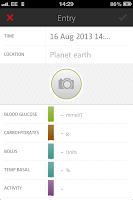
mySugr allows you to log all the things you would expect - BG (in mmol/L or mg/dl), carbs (in exchanges/CPs or grams), meal boluses, exercise/activity, basal dose for those on pens/syringes and temporary basal rates/duration for pumpers. Naturally you can also make copious notes alongside your entries which I find essential in terms of interpreting the data later. In addition you can also capture photos of meals and even add the geographical location at which the entries were made which is a nice touch. Entries can be tagged with one or more predetermined icons which range from the inevitable 'breakfast' and 'sport' to more emotional options like 'stress' or 'chilling' adding further detail to records. A very useful 'search' option allows you to quickly scan back through months worth of entries to find what you last tried for 'pizza' or 'chinese takeaway' then jump to those records to see how it went and what you might try this time.

mySugr operates on a 'freemium' basis. The fundementals of the app are available absolutely free of charge, but full functionality (eg photos with records) requires a 'pro' subscription. When you install the app you get all the bells and whistles for a few weeks. Following that you can just use the (excellent) core functions, pay a small monthly fee to upgrade to pro, or complete motivational 'challenges' to earn days of pro subscription for free by logging several entries per day or exercising. EDIT: As of January 2014 mySugr seem to be moving away from a subscription-for-pro set up towards a single payment model.

The data analysis on offer in mySugr is excellent. The home screen (above) gives you a general overview of how things are faring over the last week/24 hours in different ways. The graph itself recolours to give you instant feedback if things are altogether too high/low (red) or a bit marginal (amber). There is a logbook screen with pleasingly swooshy draggable graph and table of entries that allows you to quickly scan back through previous week/month - the graph dragging side to side as the table of entries scrolls up and down. A separate analysis screen allows you to see 7-day, 14-day and month-by-month changes in average BG and crucially the SD of those entries (how closely grouped or wildly scattered they are). Dig a little deeper and you'll see a summary of numbers of high/low readings, tags, photos and other useful detail to help you work out what has been going on. If you enjoy your own number crunching and/or want to amaze and impress your clinic with how marvellously you are getting on you can choose between different .csv formats for Excel or export your data as a slick PDF report.

mySugr is registered as a 'medical device' and CE marked (I think it is perhaps the only logging app to have achieved this). Data storage is safe and secure and the entries are seamlessly uploaded and synced in the background. I experimented early on with this and if no data connection is available mySugr will just wait patiently without pestering you until a connection becomes available. If you own more than one device you can log from whichever is closest to you at the time and the data will stay in sync on all of them.

What? No niggly complaints?
If you've read a review here before you will no doubt be waiting for the 'but...' followed by a long list of things I really hate about mySugr. Well it surprises me as much as it might you that I can hardly think of *anything* I would change about the app. I would love to be able to edit the preconfigured list of 'tags', either to just hide the ones I'll never use, or preferably to allow me to customise the text myself. The options they have are decent enough, customisation would be perfect - I gather this is on the 'wish list' for future versions. There seems to be a slight glitch with data export for Excel in that dates are coming through as text rather than an Excel-friendly timestamp. This has almost no relevance to any other user I'm sure, but it makes some of my occasional attempts at analysis/graphing in Excel go a bit wonky. I'm going to drop them a line about that, and it's just the sort of thing they fix in one of their version updates. (Edit: as expected, this has now been fixed!)

So I quite like it then?
I noticed something a few weeks ago that really surprised me. The way mySugr helps me keep track of my readings actually helps me improve them in a way no other app has done before. There is a sort of 'sliding scale' of reward and motivation going on that on one level just lets me know if things are slipping a little, but then - even when they are pretty much perfect manages to encourage me to keep trying harder. That's not a bad effort for some lines of code, comedy noises and a sprinkling of funky graphics. In general terms the BG average and SD over 24 hours 7 days, 14 days or month-so-far offer me a ready reckoner of how well (or badly!) any time period is going. I have a tendency to think 'things have been terrible for ages' so it can be encouraging to look back a few days and see that results were not so bad after all and a little basal testing will probably fix things.

Aiming for amber
For about a quarter of this year things were not going well for me diabetes-wise. Looking back it wasn't a disaster (see previous para) but every month I'd hope for a better average, lower SD, fewer highs and fewer hypos only to find that the results would be slightly worse not better than the previous month's. Despite the fact that I felt like I was trying harder. This is not particularly encouraging... But following my annual Pump Clinic at the end of June where I made some small basal and ratio tweaks things all seemed to slot into place. Day after day with bewilderingly good levels. I felt like I was winning. Even when we were away on holiday (a notoriously chaotic experience for my BG in previous years) I pushed to maintain this success*. Why? Well during this period I began to notice the 'high/low' marker on mySugr's home screen (see the big picture above) was no longer it's customary Red. Quite often it was Amber. Once or twice it was even Green! So in a rolling 7-day period I would find myself pushing to avoid a high or low reading that day, because if I could make it with a 'no hitter' then tomorrow the wobbles from this time last week would disappear and I'd be in amber again. I was playing my diabetes like a game.

The fact that my logging app was providing that motivation should make the folks at mySugr very pleased indeed.

mySugr is available for iOS devices in the App store and an Android version is currently in 'beta test'.

Final score: 5/5

* Fear not. Normality is resuming this week... along with some set failures and hilariously jaggedy mySugr graphs that well and truly revoke my #teamsmug membership.

Disclosure: I wasn't paid to write this review and I have no commercial interest in mySugr at all. I was lucky enough to be one of the beta-testing volunteers for 2.0 and have spoken to Frederik a couple of times but that's it.

Monday, 15 July 2013

All supporters need support.

Mine is a supporters voice. As Mike's wife I would like to say I am there to support him in all that he needs. I try; though I freely admit to getting as fed up of diabetes as everyone else, I am not a particularly patient person. Anyway, I think the point is that I try. I'm pretty sure we all want to try, all us supporters; but it is not straight forward.

I recently met with a friend who was diagnosed with diabetes over ten years ago. I visited him in hospital, he had pneumonia along with a heap of complications which sounded suspiciously diabetes related. I asked him whether he had type 1 or type 2. He said, "I don't know." I'm not sure how well I hid my shock, I was pretty much lost for words. My friend lives with his mother. He was diagnosed when he was thirty. He is not adept at communication.

I also know his mother, who I am sure has all the feelings that any mother has when they find out their son has diabetes. I know from Mike's mum that that can include guilt, fear, and the desire to wrap in cotton wool and never let out of her sight ever again. My friend, unlike Mike, did not talk to his mother, and his mother, unlike Mike's, did not like to push for answers to the thousand questions simultaneously forming in her head. She has had to cope alone. She hasn't felt able to admit that her son's inability to communicate has left her at a loss as to how to support him. So what she does is try to look after him. She makes sure he always has a good big bowl of cereal for breakfast, and that there is always a choice of puddings on hand after his evening meal. He happily tucks in. The only piece of advice from a dietitian she has ever been present to hear is that a combination of grapes and banana is a really bad idea.

As the mother of a diabetic diagnosed in adulthood, she has never received any support. Mike's mum was in the same position, but blessed with Mike and then of course I came along and took him off her hands, again with no support and it is scary, but Mike helped me through. I am aware that Mike and my friend are at opposite ends of the communicative spectrum, most people must be somewhere in the middle. Mike is on his way to a long, healthy life, I wouldn't be surprised if he outlived me (my family have a history of heart disease). My friend is on his way to dialysis, losing his sight, losing his feet and dying before his mother. I believe his control would be greatly improved if his mother had been offered support. My guess is that most adult diabetics don't live alone, that many don't cook their own meals, so the responsibility for the control of their condition does not fall entirely in their hands. It can and should be shared.

All supporters need support.