Showing posts with label hypo. Show all posts

Saturday, 12 September 2015

64 Days with the Medtronic 640G: Ep 9 Review - the best and worst of the MM640G

Well, this is it. The last of my posts covering my time with the Medtronic MiniMed 640G. Thank you so much for bearing with me over the last few months. Normal wittering will be resumed shortly. However, as seems to be the way of things with blockbuster franchises (HA!) I have split this last episode into two parts. Part (i) covers all the little niggles and irritations I had while using the MM640G, while part (ii) looks at the things I loved, and reviews my results including reductions (if any) in hypoglycaemia and an HbA1c I had done at the end of my time using the pump. HbA1c is the test which measures how much of the glucose in your blood stream has stuck to red blood cells. It is often used as a measure of your likelihood of developing the long term complications of diabetes.

For those who really can't bear wading through all those minutes of video I will summarise the results below. The video gives a lot more detail though, and features a fluffy bunny. What's not to like?!

When it comes to the things I really liked/disliked about the MM640G you will need to bear in mind that I am comparing to a MiniMed Veo. All of the really good stuff about pumps generally - precise basal patterns, advanced dual and square wave bolus options for tricky meals, ease of use, bolus calculator, temporary basal rates, precision of doses and correction factors, blah, blah, blah... are already assumed to be present and correct. Some of the things I loved about the MM640G are precisely because they fixed annoyances I found with the Veo. But more on that later. First:

The worst of the Medtronic MiniMed 640G

Those who have read any of my reviews before will know that I can get unreasonably irritated by the slightest things. It will come as no surprise then, that while I generally loved the MM640G both with and without sensors, there were a few things about it that drove me nuts.

  1. Pump lock
    After a few minutes the pump automatically locks and most interactions require you to play an annoying 'press the right button' game. This is no good if you are in a hurry, and is not an option that can be turned off.
  2. Change of orientation
    It's now 'portrait' not 'landscape'. As someone who wears an insulin pump on my belt this is a bit awkward.
  3. No small versions
    Medtronic have now abandoned plans to produce a smaller version of the pump. All MM640Gs will now have the little sticky-up bit to accept the larger reservoirs. The smaller reservoirs can still be used, but at present, with approximately 35u/day usage, the 'how full is my reservoir' icon on my status bar is pretty much permanently red.
  4. Sensor overtape irritation
    The glue used on the sensor overtapes (and also the little patch that holds the sensor down initially) caused a red rash to appear after a couple of days of wear. Initially it was only toward the end of a sensor but in the end it began pretty much at day 2. I used an alternative dressing, but even that was pretty itchy. Weird - because I don't usually react to adhesives at all.
  5. Sensor swap delays
    From start to finish swapping a sensor takes around 3 hours to begin providing new continuous data. That's a looooooong time!
  6. Occasional sensor lag
    Mostly I found the sensor accuracy was brilliant. But sometimes, particularly if I treated a low to try to fix a below target BG reading, the sensor was a little slow in responding (perhaps 30 minutes behind reality). Additionally calibrations by BG meter do not necessarily reach up to match sensor glucose and BG fingerstick value, but often end up with some odd half-way house. If the sensor glucose value had drifted a little there were even occasions where calibration triggered an 'alert before high' which was doubly annoying.
  7. Sensor Glucose Review
    The one-day graphs which allow you to flick back through previous days' results show no indication of SmartGuard interactions or insulin doses. Makes them about 10% as useful as they could have been.
  8. Home screen without sensors
    For no apparent reason, the icons in the status bar do not align neatly when using the MM640G without sensors. There's a gap where one of the sensor icons(!) would go, which makes it look untidy and poorly considered. The enormous dotted line 'we have no BG information to show you' panel where recent meter BG readings go (when not using sensors) also irritated me more than strictly necessary. Just doesn't feel like the visual look of the home screen for most UK users, who will be using the MM640G without sensors, was given enough finesse.

Watch the video

The grumbles, gripes, and irritations - everyone will have their own, I'm sure.


The best of the Medtronic MiniMed 640G

Whether you use the MM640G with sensors or not there is a LOT to like about it. There are all sorts of little, pleasing improvements in the interface and options that make a massive difference. Add the wizardry of SmartGuard into the mix and things are taken to another level - but even without there are lots of tasty treats for non-sensor users.

  1. Setting basals and temp basals
    There are now up to five basal patterns on the MM640G, and brilliantly you can copy entire patterns from one 'slot' to another to experiment with and then switch back if you need to later. The patterns also come with helpful names to keep track of which are which: Work Day, Day Off, Sick Day, Pattern 1, Pattern 2. Which pattern is set is not marked on the home screen, but thankfully setting any of them does not cause the 'alert circle' to appear like it did on the Veo.

    Temp basals can now be set in 15 minute increments for more precision and alter up and down by 5% at a time making them much quicker and less fiddly to set.
  2. No TBR 'chime'
    Setting a Temporary Basal Rate no longer causes the pump to issue a useless wittery alert tone every hour, which means you can ACTUALLY USE THEM OVERNIGHT! In even better news - the end of a TBR is now indicated by a single beep. Brilliant!
  3. Different Alert Tones
    There are now a series of different alert tones to indicate different things. There were a few on the Veo, but so many overlapped with either 'pip-pip-pip' or 'naah-naah-naah' that I find it much easier to work out what is going on on the MM640G without having to check the pump for 'information' alerts and being alerted (ha!) to things that actually require action. The ability to increase volume has also significantly improved.
  4. No lockout during bolus delivery
    It is possible on the MM640G to do rather more things during the time while a reasonable sized bolus is being delivered - for example you can set a TBR. The Veo made you wait until the bolus had finished before allowing you to do anything (other than stop the bolus!). This meant I could group my pump interactions together and then get on with life, rather than having to wait around tutting.
  5. Screen visibility in sunlight
    Really, really good - especially compared to some other colour-screen diabetes gadgetry I have tried. Not perfect from every angle, but really easy to turn a little and see very clearly even in direct sunlight.
  6. Remote boluses from BG meter
    Not a full remote control with bolus wizard, but a really useful standby when digging your pump out from within clothing is impractical or inconvenient.
  7. Waterproof
    Now rated as IPX8 - up to 12 feet of water for up to 24 hours.
  8. SmartGuard - overnight hypoglycaemia
    Unsurprising if you have watched my Overnight Hypoglycaemia post, but SmartGuard overnight for me was a real stand-out winner. No readings at all for 9 weeks below 3.5mmol/L overnight, and hardly any below 4.0mmol/L. Some nights almost no basal insulin required, and others requiring my more 'usual' 6-7 units at night. Looking at the results it's hardly surprising I had so many problems and so much Severe Hypoglycaemia during my years on Lantus!
  9. SmartGuard - results overall
    When compared to averaged results from 10 weeks of Libre sensors (the only other 24 hour data I have) time in hypoglycaemia fell by 90% during my 9 weeks with the MiniMed 640G. At the same time my overall levels, as measured by HbA1c fell by 0.3%. And all this with less effort and very little 'alarm fatigue'.

Watch the video

Improvements to the pump (with and without sensors) and the all important results.


Conclusion

It has been a great privilege to experience the MM640G system, and for me the results were spectacularly good. The comparison with Libre data is an interesting one, particularly where hypoglycaemia is concerned. Times wearing a Libre sensor were previously my 'best ever' results-wise. The ability to spot hypos coming during the day and try to head them off (I generally scan a Libre sensor something like 30-40 times a day), plus the ability to spot low levels overnight and make hurried basal rate changes meant that I generally had fewer hypos on a Libre than I would normally. And yet when compared to these data, the MM640G system reduced my time spent in hypoglycaemia by 90%. To be clear, that means that for every 10 minutes I spent below 4.0mmol/L trying my very hardest with a Libre sensor, I would spend only one minute when using SmartGuard. That and my HbA1c dropped over the same period from 6.3% to 6.0%. 0.3% - it's not a huge margin, but those fractions are pretty tricky to shave off once you get down below 7.0 in my experience.

My only hint of melancholy about the whole experience is, of course, the eye-watering cost of full-time sensor coverage (approx £3,500 per year inc transmitter). It's not something we as a family can afford, and full time CGM on the NHS is reserved for those who really need it most - and rightly so.

It feels a little like being given a chance to live in a multi-million pound mansion and drive an Aston Martin for a few weeks to see how I like it. I may think it's brilliant - but the reality is that it's not really an option that is really open to me long-term.

I have a pump clinic coming up in a week or two and will see what they say about the results - particularly my unpredictable and occasionally lengthy periods spent below 4.0 overnight. These do nothing to help my efforts to keep my Imparired Awareness of Hypoglycaemia under control. I may ask about the possibility of part-time sensor coverage. Even a few months in a year would make a massive difference (as long as the transmitter continued to function, of course).

My Veo is nearing the end of its warranty period, so I am looking to the future. I have some thinking and some sums to do after this experience - depending on what my clinic say.

Final verdict (with sensors and SmartGuard): 5/5
Final verdict (without sensors): 4/5
Final verdict (considering self-funding sensors): 4/5*

* because of Dexcom's more 'stretchable' reputation when it comes to sensor life

Disclaimer: I was offered a trial of the Medtronic MiniMed 640G system for 64 Days with full sensor coverage so that I could share my opinion and experience good or bad. I was not paid to write this post, and if I had thought the pump was terrible I would have written that. I was encouraged (not required) to post video blogs about my experience, but Medtronic did not have any control over what I posted.

Friday, 17 July 2015

64 Days with the Medtronic 640G: Ep 3 What is SmartGuard?

Here's another little update on my time with the Medtronic MiniMed 640G. This time it's a look at what SmartGuard is and how it works. When someone first tried to explain how SmartGuard worked to me I can remember it felt bewilderingly complicated, with all sorts of levels and numbers flying around. Actually once you have got your head around it, I have found it relatively simple - so I'm trying to explain it here with a little animated diagram that tries to work through an example of how and when Smartguard is activated, and what it does.

It should be remembered, of course, that for all it's magic, SmartGuard is not supposed to replace hypo-treatment entirely. Unfortunately for all the over-enthusiastic media hype about the 'Artificial Pancreas' when the MM640G launched, we are nothing like there yet. SmartGuard is a useful step in the right direction, but a full AP it ain't. For starters, there are many situations in which stopping your basal insulin will simply not act quickly enough, or have enough impact, to head off an impending low. And there are other situations where SmartGuard might be triggered for all the right reasons, but not actually have been needed and you end up higher than you'd like because of it.

I'll cover some of those situations in more detail in another blog - but for now, let's focus on those gentle (or not so gentle) drifts below 4.0 which SmartGuard effortlessly squashes without bothering you with any irritating alarms.

When it works well, it genuinely feels like you have a little 'diabetes helper' by your side, actively looking out for you. Not something I have ever felt about any other piece of diabetes technology.

If you have any questions or comments, please do leave them below. I'd love to hear what you think.


Watch this a little larger on my YouTube channel.

Wednesday, 8 July 2015

64 Days with the Medtronic 640G: Ep 2 The first 28 days' results

I wasn't expecting to be posting this blog today (well it seems like it'll be tomorrow by the time it has uploaded, but it's still today as I'm typing this). I had a vague plan that I'd do an introductory blog, and then move on to explain what SmartGuard was and how it worked. But today marks 4 weeks since I have been living with the MiniMed 640G and having looked at the results so far to say I am impressed is an understatement.

Ever since diagnosis, if I'm honest, I have preferred to run on the low side rather than on the high side. Lows were quick to sort out and usually involved eating something sweet and tasty, while highs took much longer to come down and, while they did not make me feel particularly grim like they do for many people, they also carried with them the spectre of all those diabetes nasties waiting in the wings. Blindness, kidney failure and amputation vs fruit pastilles seemed an easy choice to make.

Of course running on the low side and 'preferring' hypos is not a brilliant plan. My hypo awareness began to take rather a dent and I spent many years with significant hypo unawareness and the severe hypos that go with it, especially overnight. Looking back I am ashamed that I did not realise the pressure and stress that this placed on my whole family and especially Jane.

Pretty much since we began writing this blog I began to try to reduce my incidence of hypoglycaemia and regain my warning signs, and generally wrestle my diabetes into behaving itself a little better. I have put quite a bit of work in and learned a lot. Thankfully I have not had an episode of Severe Hypoglycaemia for something like 3 or 4 years now - long enough ago that I can't remember anyway. But for all the success there have remained a stubborn few dips under 4 (which may or may not be hypos depending on your definition) that I have been unable to tame.

This video blog examines what effect SmartGuard has had to my results in these first 4 weeks.


Want more updates? Subscribe to my YouTube channel.

Wednesday, 20 May 2015

Gimme 5 - a new hypo strategy

It is. Is it? Isn't it?
Here is a conversation I have had at pretty much every annual review I have ever had for my diabetes:

HCP: How many hypos are you having?
Me: Well... erm... that kinda depends on what you mean
HCP: What?
Me: On how you define 'hypo'. What you mean by it. What number or experience you use.
HCP: Erm... well... I... er...

You might think that it is a fairly simple question. Anything below 4.0mmol/L right? "Four is the floor" and all that.

Except that in the US it would be below 70mg/dl (3.9mmol/L) not below 72mg/dl (4.0mmol/L) - so suddenly there are a whole bunch of results that don't 'count' if you live over the pond just to make the US version a round number.

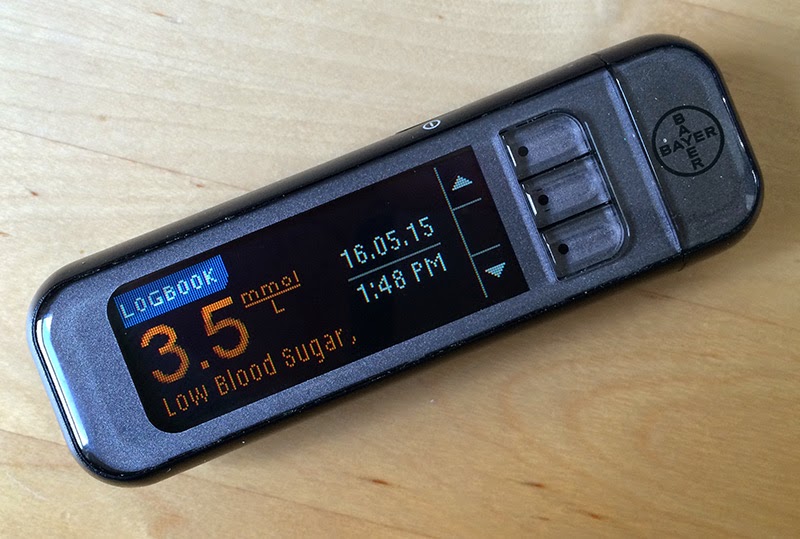
The matter is even more complicated by inherent meter inaccuracy. I have to say I trust my current Contour Next USB more than any other I have ever owned. Previously if I wasn't sure of a result I would immediately retest and could get a new result perhaps a mmol/L or two different in either direction. With my Contour Next USB, double checked results are more often than not *exactly* the same, or at most within a few decimal places. But this aside, ALL blood glucose meters are only legally required to work to within +/- 20% of a lab value. As I have pointed out before this can mean that your 4.0 (72) reads anywhere between 3.2 (58) and 4.8 (86). So which of those sub-4s would you count if some of them might be over 4 with a different strip or from a different finger? I can't spend my whole life (and all my test strips) triple-checking everything and taking the mean value...

But even if we set aside the imperfections in the data feed and assume that all the numbers are the actual numbers, it still isn't that simple. Particularly if, like me, you have ever experienced a degree of hypoglycaemia unawareness. Because you, dear non-diabetic reader, could be quite happily pottering along right now with a plamsa glucose concentration of 3.8mmol/L and no warning signs, and no one would care a hoot. For me and rest of the pancreatically-challenged horde though... things are different. If we don't get clanging warning signs at every 3.9 there is a breed of healthcare professional that will believe you are a danger to yourself, society at large and will be lucky to make it down the stairs without collapsing into a coma.

Don't get me wrong. I do not underestimate the severity of Impaired Awareness of Hypoglycaemia. Far from it. I have lived with it, and through it, and (particularly if associated with Severe Hypoglycaemia as it so often is) it is miserable for you, your family and everyone you are close to.

But if people without diabetes can be 3.8 and not hypo... then... well... er... Are we pancreas impersonators supposed to perform better than a fully-functioning non-D?!

Added to this - some guidance describes treating levels below 4.0mmol/L to avoid hypoglycaemia. From this standpoint 3.x-3.9mmol/L could be seen as offering a sort of 'buffer zone', a tiny whisker of breathing room before things might start getting messy. But 3.what?

This study suggests that most non-diabetic people will begin to experience some early warning signs in the region of 3.6-3.9mmol/L

While this study puts the level at which the brain begins to malfunction as 3.0mmol/L. And this, after all, is what we are actually trying to avoid at the end of the day.

But you don't have to have lived with diabetes for very long before you realise that the more 3.7's you have, the harder they are to spot. And the more likely you are to start getting 3.2s. And so on... and so on...


Plus ca change
And so it goes... I have some sub-4s, I try to have fewer. Some months it works. Other months it doesn't. Sometimes people are advised to 'run a bit higher' for a while (though there is little evidence that this relaxing of targets actually works to be honest). And I'm always caught by not really knowing how important a handful of readings between 3.5 and 4.0mmol/L are in the absence of Severe Hypoglycaemia and with relatively reliable warning signs that usually kick-in around 3.0-3.5mmol/L. And yet some clinic appointments make me feel like an abject failure for missing a 3.8 here or there. And the lower your HbA1c, the more twitchy your clinic tends to be about how many 'hypos' you are having - the very people who will be asked about your fitness to drive, for example. It's a quandary.


New strategy... Gimme 5
So as of this month, I have decided to try something new. I have been treating 5.0 as if it were 4.0. Any reading below 5.0 I have been treating as if hypo with fast-acting carbs (I have never been a follow-up carb person). And anything below 5.5 I have been treating more moderately with a smaller amount of fast carbs and/or a short sharp TBR - say 30-60 minutes dropped down to 10%.

Results so far are fairly encouraging. As an approach it certainly hasn't resulted in the general hike in BG averages that I have seen previously when trying to get rid of a few more of those pesky dips below 4. Hard to be sure and I'd have to run the system for a few more months but my best guess is that I might have lost perhaps 25-40% of sub-4 readings so far.

What do you think? Am I the only one who drives themselves nuts over this? How do you go about hypo-busting?

Sunday, 19 April 2015

Diabetes breakups

I'm sorry. I wish it hadn't come to this, but I'm afraid it's over between us.

I don't know why you are looking so surprised - you must have known this was coming after how things have been between us over the last few weeks.

We've been inseparable for so long now. Hardly a day has gone by in the last 5 years when I've been apart from you. All those times we've shared. All those adventures. All those scrapes we have got through together. And now it's come to this.

I know the polite thing to say is that this is down to me, but we both know that isn't the case here. It's not me, it's you. You've changed - and not in a good way. It's not just me that thinks so. Our friends have noticed the change in you too. And I'm afraid I can't go on living with you like this. You have let me down, when I needed you most. And then when I forgave you and tried to go on as before - you just went and let me down again, and again. And now I hardly even recognise you. I just don't know who you are any more.

Maybe you are looking for someone else? Someone with deeper pockets maybe? I hope you'll find someone for your future, but I know for certain that it isn't me - not while you are behaving like this.

And it breaks my heart, because we have been in this together for so long. Perhaps I came to rely on you too much? There were times when I thought I could accomplish anything as long as you were by my side. But now? Now I'm just waiting to be let down. Waiting to be abandoned. I can't trust you - and I can't be with someone that I can't trust.

I'm not angry I'm disappointed. And angry.

So I'm sorry, but I've found someone else.


For those who have *no* idea what I am going on about... after many years of faithful togetherness it seems that Fruit Pastilles (my pocket-based hypo remedy of choice) have changed their formulation. Over the last fortnight I've had to ditch large parts of several packets which became an unusable gooey mess covered in irremovable tinfoil, occasionally plastered to the inside of my jeans pocket. Nice. The worst discovery was during a training run for my forthcoming 10km road race in support of INPUT. Feeling a bit low and discovering half the remaining pastilles rendered useless 5km from home put me in a pretty tight spot for my run back.

Friday, 16 January 2015

Medtronic MiniMed 640G 'SmartGuard' Pump - Preview

The Medtronic 640G launches Feb 2015
I was absolutely made up to receive an email a few weeks back that invited me to go along to the Medtronic UK 'Bloggers and Patient Advocate' meeting in sunny Watford today. It seems that Medtronic are keen to connect a little more with the diabetes online community in the UK, share a little of what they are up to and generally get some grass roots feedback. The group is a mix of MDI and pump users (Medtronic, Animas and Roche, with and without various CGM alternatives all present). It includes both people with diabetes and parents of children or young people with diabetes. It was lovely to meet up with a glittering array of familiar and less familiar faces, Annie (@understudypanc), Lesley (@INPUTdiabetes), Laura (@ninjabetic1 and #ourD), Lindsay (@LwSweetpea88), Sue (@desangsue), Dave (@SowerBee), Chris (@grumpy_pumper), Paul (@TheTeamBG and #GBdoc), Gavin (@Diathlete), Kris (@diabeticbanana), Kyle (of @mysugr), plus @JDRFUK youth ambassador George (and his mum!). We were joined by 6 folks from Medtronic who were very excited by some of their new toys that are just about to launch. I believe that this group has met several times before with more of a 'brain-picking' workshop feel, but today was much more of a full-on sales pitch with a sneak peek of the new MiniMed 640G insulin pump which launches in the UK, Sweden, Denmark and Australia on the 1st 2nd of February (regrettably it looks like FDA approval for the US could take years). We were lucky enough to get a short amount of hands-on time to play with the 640G and I just wanted to share a little of what I saw today. I won't be able to go into too much detail for a full-on review here I'm afraid, because there was LOT of information shared and while I tried to take some notes, all too quickly we had to hand the devices back in. Plus since the official website doesn't launch for another couple of weeks I've nothing to check against. I will try to get someone from Medtronic to glance over the post and set me straight if any of this is complete nonsense. I'll post (and add think about ignore mark) corrections as necessary :)

Those familiar with Medtronic's Veo may have come across the term 'Low Glucose Suspend', the facility where overnight the Veo (when used with Enlite CGM sensors) can automatically stop basal insulin supply if the pump detects a predetermined low glucose threshold has been passed. This has been shown to significantly reduce the severity and duration of overnight hypoglycaemia in clinical trials and was welomed (particularly by parents of T1 children) as a major step forward towards developing the 'artificial pancreas'.

The MiniMed 640G takes this approach to a whole new level with 'SmartGuard', an algorithm that begins to take effect significantly before you have hit your 'low' level, attempting to dodge some of those pesky hypos altogether. The sensors are Enlites again, but with a new (and apparently much improved) 'Guardian Link' transmitter to boost performance.

More on that later, but first a quick overview:
  • Colour screen which apparently reads easily in sunlight
  • Waterproof (yay!) including swimming
  • Reservoirs available in either 180u and 300u
  • Up to 5 different basal patterns with up to 48 rates per 24 hours each.
  • Pairs with Contour Next Link USB (new 2.4 version)
  • Limited bolus options via meter, full bolus wizard on pump
  • Completely re-worked interface with many more 'user-friendly' options and updates
  • More customisable alarms (and at louder volumes)
  • Already licensed for use by children
  • Size-wise it's very similar to the Veo, just a few millimeters taller, wider and deeper

SmartGuard
The thing Medtronic were clearly most excited about was obviously 'SmartGuard', so it's probably worth trying to note down what I can remember about how that works. SmartGuard builds significantly on the premise of Low Glucose Suspend by making the whole thing much more predictive. While Low Glucose Suspend only kicks in when you are already registering low, SmartGuard acts earlier trying to head off the low by temporarily stopping basal (in much the same way I started doing while wearing a Libre sensor - see 'new technique'). They had a snazzy graph in the presentation to explain how it works, which I've attempted to recreate here. On the pump you set a 'low' limit that you do not wish to fall below - anywhere between 2.8 and 5.0 in 0.2mmol/L increments. Above that the pump sets additional 1.1mmol/L and 3.9mmol/L guides. SmartGuard is triggered if sensor glucose values fall below that upper line (3.9 above your low limit) AND are falling sharply enough that you are predicted to fall below the 1.1 line within 30 minutes. All insulin is stopped for at least 30 minutes from that point (including basal and any partial dual or square waves still in progress). If your numbers stay down, the insulin stays off for a maximum of 2 hours. Basal delivery (only) automatically resumes once you have risen above the 1.1 line AND are predicted to remain there for the next 30 minutes. Users can, of course, cancel the SmartGuard intervention at any point (eg if they would prefer to treat the impending low with some tasty fast-acting carbs. Rather neatly you can also choose whether or not the 640G alarms or alerts at any of those points and even tailor what times of the day (or night) to switch SmartGuard on or off. Alternatively you can simply run the system as the current Low Glucose Suspend works.

It was claimed that in the 'Pilgrim' study, the same algorithm that powers SmartGuard was able to avoid 80% of potential hypoglycaemic events both day and night. If those results could be reproduced 'in the wild' it would be nothing short of groundbreaking. A handful of people have recently been able to use the 640G on a trial basis at Kings College Hospital and two of them (including @desangsue) shared their experiences. Responses from other hands-on users are also very encouraging and seem to suggest that many found SmartGuard alone was sufficient to cope with moderate exercise. After a short while to build trust, many were also happy to simply let SmartGuard do its thing silently and alarm-free, only realising when checking the pump later that they had been spared a low-level dip here or there by some automated basal jiggery-pokery. The only mandatory alarm that sounds would be if your sensor glucose fell below your 'low limit'. This is a good thing. But the customisability of those alarms, while preventative action is automatically taken without confirmation being required seems to go a long way to prevent CGM 'alarm fatigue'.

Fancy new meter
The 640G pairs with a Bayer meter that looks just like the existing Contour Next USB, but this souped-up '2.4' version has some extra cleverness under the hood. For starters you can use it to deliver a quick manual bolus of any number of units you choose without having to fish the 640G out of your pocket. You can also create up to 8 bolus presets (which can include predetermined square or dual-wave options and doses) on the 640G that can be fired from the meter. Frustratingly you cannot vary the doses of these presets from the meter itself at the point of delivery - which would make this much more useful for me - and neither can the meter act as a fully fledged bolus wizard as it does with Roche pumps. However *some* meter bolus options are certainly better than none, and I can see that these could be very useful for snacks and preset mini-corrections or standard preboluses. The new BG meter also acts as the USB conduit for uploading data to the Carelink software package which (mercifully) is also getting a complete overhaul very soon.

Sensors schmensors
That's all very well you may say, but I'm about as likely to get funding for full time sensors as I am to become the next Pope - is this all about SmartGuard, or is there anything here for non-CGMers?

It is true that Medtronic are putting a lot of emphasis on SmartGuard - they are keen to describe the 640G as a 'system' rather than just a pump. It seems they are trying to work with Healthcare Professionals and NICE, seeking to allow more people to access this sensor augmented, 'virtual pancreas' approach. Swift murmerings were made about price points and volume but no real detail given as to if (and how much) sensor cost may fall if there is a greater uptake.

However even without all that sci-fi automation there is much here to please regular pumpers.

A colour screen is pretty much a given these days, but the layout and icons here are well thought through and in themselves allow quick access to a detailed and drillable overview, similar to but richer than the 'back button' on old MiniMed pumps. Bolus and basal adjustments are available direct from the 'home' screen, and everything is navigated by the 4-way/OK controller plus two other buttons - one for 'menu', the other for 'back'. Pleasingly, pressing and holding the 'back' button takes you directly to the home screen however deeply you are embedded in within menu options, which is a nice touch.

A great deal of attention seems to have been paid to the available options to make the pump more customisable and personalisable for individual users. For many things (such as basal patterns) you can now choose named versions eg 'work day' or 'illness' that make them more self explanatory to use, alternatively you can still opt for the more usual numbered options. You also have the option of setting all sorts of presets, including temporary basal rates of predefined length/intensity (again with named alternatives). Whatever you choose to populate from the available options in setup screens get shown in the selection menus, but you don't have to wade through dozens of items that you never use if you don't want to set them up. So you might choose to set just two of eight available TBR presets one for 'moderate activity' and another for 'light activity', then when setting a TBR you can choose either of those or dial in a custom one. Overall it felt logical, intuitive and that several regular tasks would be faster to achieve. The added complexity might mean an additional button-press here or there for one or two things, but in the hour or so we had to play with the 640G most things I wanted to access within a few presses I could.

Battery life is anticipated to be around 2-4 weeks, depending on use. The 640G needs the slightly larger AA batteries (rather than the Veo's AAAs) to power the colour screen. In the top menu bar the battery (and other) icons re-colour to indicate their status. On the battery front, as well as the usual 'low battery' warnings at 25% and again (if I remember right) at 5% there is also an inbuilt 'get out of jail' rechargeable battery that will allow the pump to limp on for up to 8 hours if you find yourself stranded in a motorway traffic jam or somewhere with no shops over a Bank Holiday having paid no attention to the icons/alerts when you set off. I also unwittingly tested the "what happens if you need to change battery in the middle of things" situation and a trial TBR I had set running happily carried on after I took the battery out to have a look. Another neat trick is that the standard-issue belt clip can be swiftly detached and is moulded in such a way that it can be used instead of a coin to unscrew the battery cap. Just a nice bit of attention to detail which speaks highly of the amount of effort Medtronic have put into the design of things.

Infusion sets and reservoirs are exactly the same ones used in the Veo, but special mention must go to the 'Infusion set change' alarm which you can set as a reminder. This particularly caught the imagination of Paul B who said that as a feature, it was pretty much enough to win him over on its own.

My biggest disappointment on the day was to discover that those infernal (and entirely useless) TBR hourly chimes are still present on the MiniMed 640G and it doesn't look like you can turn them off either. After all the effort that has clearly gone into usability and user-experience... The mind boggles. [EDIT: This turns out not to be the case after all. See the end of my compare/contrast video blog for details.]

To be honest I'm going to have to stop there - it's suddenly got rather late and I had thought I was just jotting down some quick notes. It was a very interesting day and there were other snippets (such as the iPort) that will have to follow later.

In short, I will have had Artoo for 4 years in November this year, at which point the warranty runs out and my robot counterpart begins to live on borrowed time. While I'm not champing at the bit for a new pump, I had absently been wondering what I might look at next. I am still interested to find out more about Roche's Insight pump. Omnipods don't feel right for me, and until today I was fairly certain that the Animas Vibe was my front runner because of Dexcom integration (and longer sensor life if I ever take the plunge to self fund). I know that for many the lack of a fully functioning remote handset on the 640G will be a dealbreaker, but that really doesn't bother me much. Today has given me much to think about and Medtronic's new offering very clearly sets itself apart in the market by doing something that absolutely no other pump can do.

Video blogs now available

Update: I have been given the opportunity of trialling the MiniMed640G for 64 days and will be posting video diaries of my experiences. Watch the videos.

Disclosure. Medtronic generously paid my train fare and laid on a tasty lunch. I was not asked and have not been paid to write this post or publicise their products in any way, but thought you lot might be interested.

Tuesday, 15 May 2012

DBlog Week Day 2 : One good thing

When I looked down the list of topics for DBlog Week I knew this one was going to give me some trouble... Something about diabetes that I nearly always do well? Talk about a hypodermic in a haystack. Tomorrow's topic of something I need to improve on is noooooo trouble at all. How many would you like? How long have you got? But something diabetes-related that I do well? Hmmmmm...

I nearly wimped out and posted about how brilliantly supportive and understanding my family is (however grumpy I get). Or how amazing the information, hints and tips are that come flooding from all corners of the DOC at the first keystroke of a 'Bah! Having a rubbish day today' tweet. But then it struck me as I fished a fluffy fruit pastille out of my pocket to counter what might (or might not) have been a slight dip in BGs. There is a little thing that I have done ridiculously well ever since I was diagnosed. Every day! It's so much a part of my life that I no longer even think of it, but occasionally when it is mentioned to non-D types I get met with a raised eyebrow and just a hint of "Well that's a bit weird" behind the eyes.

I am amazing at carrying hypo treatments around. I don't think I've gone anywhere in the last 20-odd years without pockets full of goodies 'just in case'. In sweetie-carrying terms I am way more reliable than a Werthers Grandfather (who only managed a measly 15 years). I have treatments. I have backups. Occasionally I have backups of my backups.

Just after I was diagnosed I was advised that I'd have to carry something sweet on me at all times. I found a little tin in a giftshop that had a nice vintage-label design printed on the lid. Initially I carried dextro-energy tabs in it, but they were vile and I discovered that it was just big enough to carry three of four sachets of sugar - the kind you get in cafés and coffee houses so took to carrying them instead. For many years I siezed hypos as an opportunity to have a funsized chocolate bar (even after I knew that chocolate was nothing like fast-acting enough really). I would have chocolate in my coat pocket and the tin in my jeans. The tin became my 'last line of defence'. If ever I was anywhere and the shops were shut or there was just nothing around I would at least have something that might keep me going. I began to develop heirarchy of treatments based on their suitability to the time of year. Skittles and Jelly Babies come in small bags in some funsize assortments and are virtually indestructible in a jeans pocket during the Summer - even in 80% humidity and scorching temperatures on a brief stay in Singapore.

These days my weapon of choice in tackling hypos is certainly Fruit Pastilles. A whjole pack is just a tiny bit too long until you have had the first two or three but I like to think the extra strain that puts on the tube gives it a lovable 'crumpled' quality. And the hypo-addled T2 came across and helped out a few months back didn't seem to mind. (I was able to give her a spare pack that was acting as the backup to my backup).

And the tin still goes with me. Everywhere. There's not a scrap of paint on it now, of course. It has been polished to a gleaming shine by thousands of hours in my pocket, and is just very slightly dented.

Tuesday, 8 May 2012

Face-off: MDI vs Pump


A couple of people who are considering going on an insulin pump were asking how I was getting on, how I was finding it and whether I thought it had made any difference. 

An interesting question a little over 6 months into the experience. 

Pump win(?): Fear of attachment
The first thing to say is that the nagging worries I still had about attachment when I wrote a few weeks after starting on a pump have long gone. I know some people feel at one with their robot pancreas almost immediately, but it took me a good few months before I reached the stage where I rarely thought about being hooked up to Artoo, and even when I did, it didn't worry me. Things like getting changed, where the sense of inconvenience lingered, no longer strike me as irritating. If you have just started on a pump, and the attachment still frustrates you, hang in there. Not everyone gets used to it in a few days. Allow yourself time to adapt to the new 'normal'. Wearing and using Artoo is now second nature. No problem with sleeping either. 

Hugely unexpected pump win: Attachment
I think this bears repeating from my '2 month' post, partly because it was something I really didn't see coming. There have been many times since starting on a pump that being attached to Artoo 24/7 has given me back a feeling of spontaneity. Do you remember spontaneity? I'd pretty much forgotten about it myself too. That ability to just stop and have lunch there because you fancy it, rather than having to go back home because you weren't expecting to be out that long and didn't bring your kit. There have also been *no* times since November when we've had to stop the car at the end of the street, and run back to fetch my pencil case.

Pump win: Basal patterns
A properly flexible basal pattern was one of my main motivations to switch to a pump. Looking back, while on MDI my early morning 'fasting' reading of the day was more erratic than I realised at the time. Sometimes too high, sometimes too low. Only in a decent range say, between 3.9mmol/L (70mg/dl) and 7.5 (135), less than half the time (45% to be exact). Truth be known it's still wobblier than I'd like, but these days I get a decent first reading on two out of three days. That's a much cheerier start to the day for everyone at the breakfast table.

Pump win: Delivery options
I was invited to an evening arranged by Medtronic in March where pumps and pump therapy were discussed. It surprised me how many people had been on a pump for years but had never tried out different bolus patterns or temporary basal rates. If you are new to a pump I'd encourage you to get stuck in straight away. TBRs, dual and square wave boluses have more than lived up to my expectations. Many situations, like gardening and vacuuming which refused to play nicely for me on MDI have been more or less tamed by Artoo. I don't get it right all the time, but have a little 'cheat sheet' of notes for what seemed to work before to use as a basis for whatever I'm doing and I have avoided many many spikes and/or hypos since November.

MDI win: Infusion site failures
On the plus side set changes have become much easier and more automatic. They are a little more time consuming than a simple injection, but you do know roughly when they are due and can bring that forward/push that back slightly if it would come at an inconvenient time. The whole push-button dosing thing is so much quicker and easier than faffing about with a pen that my feeling is that I have a net gain of time spent/inconvenience endured dealing with diabetic rigmarole.

But. (and it's a biggie)...

I have had sites go wrong already. I still watch every set change carefully to make sure they have 'taken' properly. I had almost stopped being so paranoid, but two or three failures in quick succession have put me on my guard again. At least two cannulas have kinked on or after insertion so that insulin wasn't being infused properly. Not serious enough to get a 'low delivery' warning, but enough to cause a rise in BG levels. I had another site seemed to 'go off' at about 1.5 days. It had been fine, but suddenly stopped working as expected. I am putting these down to site issues because corrections did not behave properly, but as soon as the site was changed I was back on an even keel. I've also caught a big fat bubble in the tubing on at least two occasions when I've put Artoo back on after a shower/gym session - which makes me wonder if some odd but short lived rises in BG might be down to Artoo delivering 'bubble' rather than basal for an hour or two on other days. I check carefully every time I fill a reservoir and flick and fiddle until I am as sure as I can be that I have got all the bubbles out, but nevertheless I can still sometimes see a bubble in the reservoir at the next set change. These are not problems that you ever have with MDI. Even if you hit a dodgy site that is only going to be one out of the day's several injections. With Artoo all my eggs are in one basket. And sometimes the handle falls off the basket. I have had one-off levels on a pump higher than I've had for years on MDI, perhaps the highest since I was first diagnosed. And I've also tested positive for ketones since November - again not something I am used to. In all I've probably had to swap out maybe six sites since November. As a percentage of the total number of insertions it's not disastrous. but it's not ideal either.

MDI win: Injection site availability
Another part of this is the available site locations. I was never very adventurous on MDI, but I had far more area to play with in terms of a quick injection than is suitable to have something fixed to it for several days. I'm currently using sides and back for sites to give my abdomen a rest but have to be careful to find a spot with enough 'flesh' and some places end up being slightly uncomfortable when you lean on them/sit on them/risk getting them knocked out by waistband. In theory I could use my thighs, but there's not a lot of 'spare covering' there and most of the usable area seems to be right underneath my jeans pockets which I'm forever fishing stuff out of. I worry I'd just pull the site out when trying to get hold of my my keys.

But what of the results so far?
It's never very easy for me to spot how things are going from day to day. A couple of good (or bad) days on the trot and it can feel like I'm some sort of perpetual Diabetes Superhero/Catastrophe. Sometimes it feels like I've been having a problem for months, but looking back just a week or two and it becomes clear that it has only been a matter of days. 

So I dug back through my records and picked some results to compare from three periods. Some old paper records from around the time we started writing this blog, some records towards the end of my time with the Accu-Chek Expert and some more recent ones with Artoo. I pulled 60 days of results to try to reduce the impact of a dodgy few weeks. I avoided holidays/Christmas or other challenging times of year and tried to pick a couple of 'normal' months for each. I knew things have been getting better for me in recent years, but I've not really compared and contrasted in this way before. 

Testing frequency was roughly even in each case (between 7 and 8 times a day) and are made up of a mixture of waking, pre meal, post meal and bedtime tests. 

The first thing that surprised me was how much improvement I had been able to make on my own with MDI, even before the help of the Expert. Due to an, ahem, administrative/back-up error I don't have a full 60 days immediately pre-Expert to compare, but even so, before Artoo the number of highs and lows were substantially improved.

Hypos - below 3.9 (70)
Old MDI was the worst with 20% of readings, the Expert reduced this to 10% of readings and Artoo has made a small improvement taking this down to 8.7% - clearly Artoo and I still have work to do here.

Hypos - below 3 (54)
The old MDI records really don't do well here, with almost half of all hypos coming in below the 3 (54) mark. Compared to what I'm used to in recent years it made uncomfortable viewing. Both the Expert and Artoo fare much better with 2.4% and 2% of all readings coming in at that level. Both with the Expert and with Artoo, none of these hypos have been 'nasties'. I can't remember the last time I had a really bad one it was so many years ago. I've been functioning, spotted them and able to treat them all myself. That may not have been the case with the old MDI records.

Highs - above 10 (180)
The same pattern of worse, slightly better, better again repeats here. Old MDI shows 19% of readings over 10, with the Expert that falls to 16% and reduces to 13% with Artoos assistance.

Highs - above 13 (234)
This is where Artoo really shines at the moment. Despite having subjected me to an occasional stratospheric BG with a dodgy set, in the 60 days of data Artoo only allowed 0.04% of readings to stray over 13. The Expert does surprisingly badly here with 6% while even old chaotic-style MDI scrapes in with 5%.

Averages and SD
While averages can hide a multitude of unpleasant detail, I think that here they do seem to suggest positive progression. The old MDI average was 6.8 (122) with an SD of 3.3 (59), the Expert improves this with a slightly higher average 7.2 (130) but reduced SD of 3.0 (54). Artoo though trumps them all with the joint lowest average 6.8 (122) and a significantly lower SD of 2.4 (43).

So is it worth it?
YES! Absolutely. The ways in which Artoo has made my diabetic life easier to control, more spontaneous and simpler to get along with far outweigh the remaining niggles I have about infusion sites. Is it like being non-diabetic? No of course not. Actually I have to watch myself not to feel downhearted if I don't have perfect levels all the time because some mad part of my brain thinks that in theory this ought to be possible now. Well unfortunately Diabetes is still incredibly annoying and has lost none of its ability to throw out the rulebook and move the goalposts for weeks at a time. I don't suppose it ever will.

I have an HbA1c coming up in the next few months. It will be interesting to see if there is an improvement - my first post-pump A1c showed an 0.5% increase and I'm hoping I might be able to match my previous MDI result but with fewer highs and lows into the bargain.

We shall see.

UPDATE: Regarding set failures - I wrote this some months later. Set changes

Monday, 16 April 2012

The diabetic half hour

Just having to rattle this one down. I've got several other 'proper' posts jostling in my head, but this one has just emerged and rudely pushed its way to the front...

Is it just me or do many other diabetics seem to spend an interminable amout of time just waiting around? I'm not talking those charming hours spent in the cosy nooks of a doctor's surgery or the peace and tranquility of a clinic waiting room - I just mean the day to day business of pretending to be a pancreas. The waits I am talking about always seem to last about 'another half an hour'.

Wake up, test BG, bolus, pour coffee. Look at watch and think, "Better wait about half an hour for that insulin to realise it's meant to be doing something useful before I take the rash action of eating something."

Lunchtime, test BG, bolus, see above...

48 minutes after lunch. Hmmmm I wonder if I guessed that dollop of whatever right. Bit early yet, better wait about half an hour before testing to allow for the dose/food to get going.

Oops, got that wrong. 9.something... If I walk to the shops that'll sort that out. Back from the shops. Wonder if that worked. Better leave it about half an hour for that sort of low-level exercise to have any effect I suppose.

Evening meal (inexplicably spared the need for a pre-meal half hour wait). Look at watch, 56 minutes since finishing. Bit early yet. Better leave it about half an hour before seeing how things are going.

Bedtime. Dual wave finished some time ago but there are still a fair few units (and some takeaway) doing their thing. Better leave it a while before turning in. There... was that long enough? Ah no... that was only 27 minutes, better leave it about another half an hour.

I'm sure if I had all those back and added them together I'd have about twice as many hours in the day! And half an hour is not quite enough time to do any one thing, but slightly too long to do nothing. It's a time period where it's easy to get distracted and forget what you were supposed to be doing (waiting to eat after bolusing is a nightmare for this).

And a lot can happen in half an hour, diabetically speaking. You can be waiting to give it long enough to check and all the while your BGs can be rocketing skyward. 30 minutes of rapid climb meaning it'll take even longer to resolve.

Case in point yesterday: I had tested to find a couple of low level dips in the morning where I'd underestimated the level of activity and not sufficiently reduced basal. In the afternoon I feared the same was happening again, but rather than testing I just topped up here and there with a sip of Lucozade or a fruit pastille. Before evening meal I was an entirely self-inflicted 12.2 (220). Not ideal. In an attempt to speed the return to better levels I left Jane washing up (sorry about that) and went for a brisk 40 minute walk. Once back I waited for things to settle (about half an hour, of course) but then found that rather than improving things I was up to a wince-inducing 24.8 (446). Frustratingly I rarely feel any symptoms with quick rises into kidney-frying territory so I had waited none-the-wiser while my liver had decided that my BG was far too high to be walking about and what I really needed was an additional surge of glucose. Great. Thanks for that.

On the other hand I had changed set just before evening meal so maybe it was nothing to do with the walk and it was just a set failure?

A full 5 unit correction administered there was nothing to do but wait and see if thigs got better or worse. Ready yet? Nope, not long enough. Another half hour should do it... (I always seem at least twice as eager for a correction to start working as it is able to start reducing BGs).

Thankfully I did come down overnight, and very smoothly too. Artoo earning back my trust with a 6.5 (117) at 2am, followed by another 6.5 (117) on waking this morning.

Yet another day when I would *love* the immediacy of feedback that a Continuous Glucose Monitor offers. Ah well, without a lottery-win (unlikely as we don't do it) that isn't going to happen with the current pricing structure.